
Quick Summary
Learning how to fix a sagging wood gate starts with diagnosing whether ground dragging stems from loose hinge fasteners, a racked frame, or structural post deflection. While misaligned frames can often be squared using rigid diagonal compression braces or tensioned turnbuckle cables, severe post rot and heavy frame loads require professional reinforcement solutions from Ironworks Gate Co. Readers will understand how to complete a five-step DIY repair process and recognize when to schedule a professional on-site assessment for permanent post and hardware restoration.
How to Fix a Sagging Wood Gate: Stop Dragging in 5 Steps
When a wooden gate begins scraping the ground or missing its latch, the issue usually comes down to loose hinge hardware, a racking frame, or a hinge post that has started to lean. Heavy gates frequently sag over time under continuous gravitational load. While anti-sag kits are popular options, repair methods recommended by specialists like Ironworks Gate Co. should be selected based on the specific source of movement. Note that specific repair techniques mentioned here represent general practical guidance that may require separate verification for particular installations.[3]
In manufacturing and installation standards, a 1% sag figure is recognized as a design standard for fabricated and hung gate frames, rather than statistical evidence about residential wood-gate sag frequency or repair success. Fixing a sagging gate involves diagnosing the failure point, securing hardware, stabilizing the frame, supporting the post, and maintaining the assembly over time. See also Automatic Gate Repair – Call Now-10% Off – On-Site in 60 Minutes – Free Estimate.
Quick Summary: How to Fix a Sagging Wood Gate
Practical guidance for fixing a sagging wood gate across five key areas:
- Step 1 – Diagnosis: Identify whether sag originates from loose hardware, frame racking, post deflection, or environmental moisture changes.
- Step 2 – Hardware: Tighten, reinforce, or replace hinge fasteners and mounting plates to eliminate movement at the pivot points.
- Step 3 – Bracing: Apply practical diagonal bracing – such as a rigid diagonal brace or a tensioned cable turnbuckle – to restore frame alignment.
- Step 4 – Post and gate support: Correct leaning posts and provide support at the free end of heavy hinged gates to relieve constant pressure on the hinge post.
- Step 5 – Inspection and maintenance: Perform regular inspections of hinges, latches, fasteners, supports, and swing paths, lubricating and adjusting hardware as needed.
What You Need to Repair a Sagging Wooden Gate
Note: Hardware selection, tool choices, and repair procedures serve as practical recommendations and should be adapted to your gate’s specific construction.
Recommended Tools
- Carpenter’s level
- Tape measure
- Cordless drill or driver
- Pry bar and wood shims (or scrap wood blocks)
- Wrench or socket set
- Safety glasses and work gloves
Hardware and Replacement Materials
- Exterior-grade structural wood screws or replacement fasteners
- Heavy-duty gate hinges suited to the gate’s weight
- Dimensional lumber for rigid diagonal cross-bracing
- Turnbuckle anti-sag cable kit (galvanized or stainless steel)
- Exterior wood glue and wood plugs or dowels for stripped holes (as needed)
- Concrete mix (if stabilizing or resetting a post)
Step 1: Diagnose the Exact Cause of the Gate Sag
Need how to fix sagging wood gate?
We’re available now - call for a fast, free estimate.
Before making structural changes, examine each part of the gate assembly to determine where movement has occurred.
-
Check the Hinge Fasteners and Hardware
Inspect the gap between the hinge post and the gate frame. Lift the free end of the gate slightly to observe whether the hinge leaves pull away from the wood or if mounting screws have loosened in their holes.
-
Check Frame Squareness and Moisture Effects
Measure diagonally across the frame from corner to corner in both directions. If the measurements differ, the frame has racked out of square. Wood continually undergoes moisture-content changes throughout its service life. Controlling moisture during drying, storage, and construction, plus installing wood at a moisture content suited to its service environment, helps minimize dimensional changes. As a rule of thumb, wood gates longer than five feet require frequent maintenance due to frame weight and environmental movement.[2]
-
Check Hinge Post Plumb
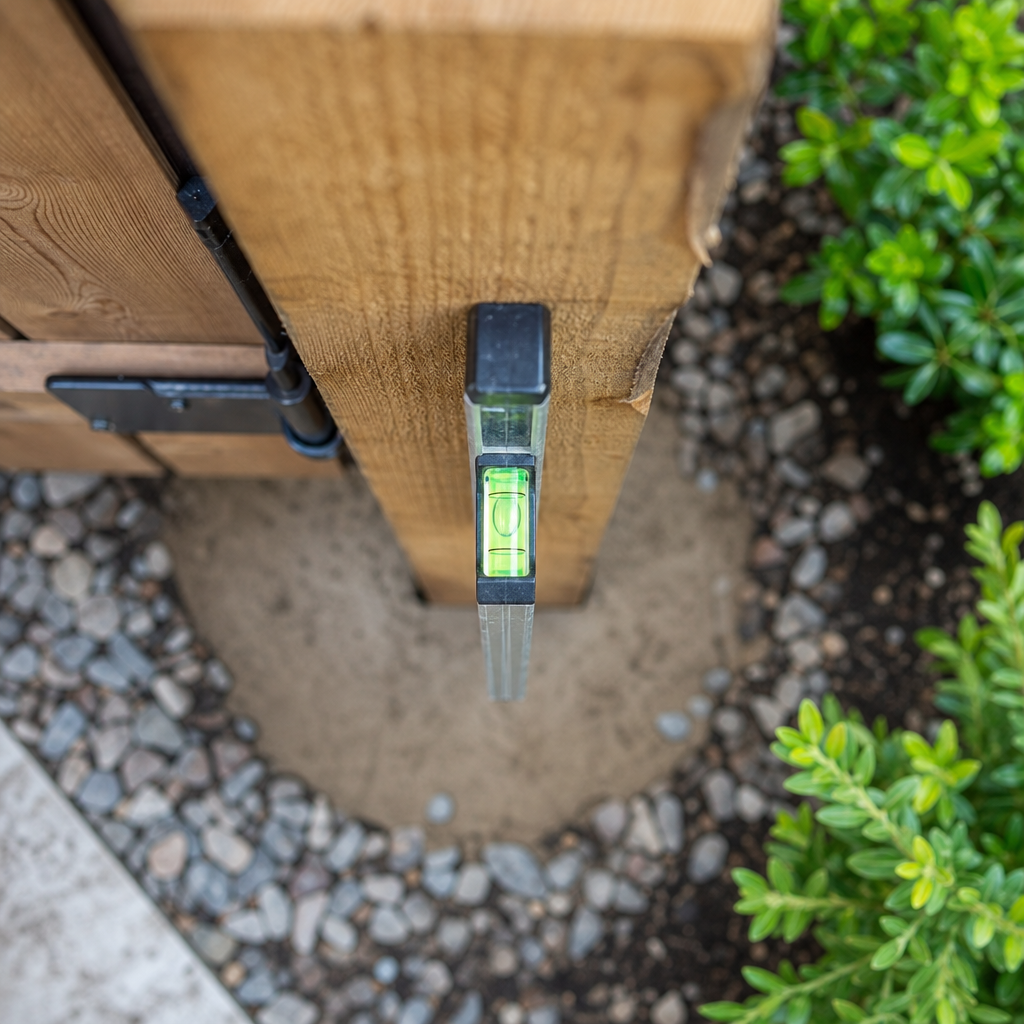
Place a level vertically against the hinge post. Heavy gates frequently sag over time because the gate exerts continuous leverage against the post. If the post itself leans toward the opening, adjusting the gate frame alone will not provide a lasting correction.
Step 2: Tighten, Shim, or Replace Worn Gate Hinges
Loose or undersized hinge fasteners are a common cause of latch misalignment and gate dragging. The following hardware steps provide general practical guidance:
- Support the gate: Place shims or a support block under the free end of the gate to relieve weight from the hinges before adjusting fasteners.
- Address stripped fastener holes: If mounting screws spin freely, remove them and fill the enlarged holes with glued wood plugs or dowels, allowing the glue to cure before driving replacement fasteners into solid wood.
- Install appropriate structural fasteners: Replace short or corroded screws with heavy-duty exterior fasteners long enough to anchor securely into the framing and post.
- Consider adjustable hinge hardware: For heavy gates, adjustable hinges can provide a practical way to re-align the gate if seasonal shifting occurs.
Step 3: Install an Anti-Sag Cable Turnbuckle or Diagonal Brace
When the post is plumb but the frame has racked out of square, diagonal bracing provides practical support, as noted by the technicians at Ironworks Gate Co. Based on practical carpentry and question-answer guidance, braces are typically configured according to their material properties:
Rigid Wood Diagonal Braces
As a practical guideline, a rigid wood brace is installed to act in compression, running diagonally from the bottom hinge corner up toward the top latch corner. In this orientation, the brace transfers load from the unsupported outer edge down to the lower hinge support.
Turnbuckle Cable Systems
A cable turnbuckle system operates in tension, pulling the outer corner upward:
- Mount corner brackets: Secure the upper bracket near the top hinge corner and the lower bracket near the bottom latch corner.
- Extend the turnbuckle: Extend the turnbuckle threads before installation to ensure sufficient travel for tensioning.
- Attach and tension the cable: Thread the cable through the brackets and turnbuckle, pull out initial slack, secure the cable clamps, and rotate the turnbuckle body to draw the frame square.
Step 4: Re-Plumb and Support the Hinge Post
Need how to fix sagging wood gate?
We’re available now - call for a fast, free estimate.
If the hinge post leans under the gate’s load, stabilizing the post and supporting the gate’s free end is necessary to prevent recurring sag.
- Relieve gate load: Remove or fully support the gate before attempting post realignment.
- Re-align the post: Adjust the post until it is plumb in both planes, using temporary bracing or winching as site conditions require.
- Secure the foundation: Reinforce or reset the post footing with concrete, shaping the surface to encourage water runoff away from the base.
- Install free-end support: Substantial-weight hinged gates should have support at the free end when open or closed to reduce constant pressure on the hinge-side post. A latch-side ground rest, catch block, or resting post helps distribute weight and prevents continuous strain on the hinges and post.
Step 5: Inspect Clearance, Supports, and Ongoing Maintenance
Once the gate is aligned and swinging freely, conduct a complete final inspection and establish a regular maintenance routine.
- Check for obstructions and clearance: Verify that the gate swings clear of turf, soil, pavement, and seasonal debris throughout its entire swing path. Grade soil or adjust clearance as necessary to prevent dragging.
- Verify free-end supports: Confirm that resting blocks, catches, or support points engage properly in both the open and closed positions to relieve resting loads.
- Routine maintenance schedule: Regularly inspect hinges, latches, fasteners, mounting hardware, gate supports, tracks, and potential obstructions. Lubricate pivot points and adjust hardware as needed to maintain smooth operation.
When to Repair vs. Replace a Sagging Wooden Gate
Evaluating whether a gate can be repaired or needs rebuilding depends on the physical condition of the lumber, according to guidelines from Ironworks Gate Co.:
- Repair if: The structural members and post are sound, fastener holes can hold hardware securely, and misalignment is limited to loose fittings, rack in the frame, or minor post lean.
- Replace if: Extensive fungal rot, severe splits along structural framing lines, or deep warping compromise the timber’s ability to support fasteners and structural loads.
Frequently Asked Questions
Which direction should a diagonal brace go on a wood gate?
In general practical guidance, a rigid wooden brace is installed in compression from the bottom hinge corner up to the top latch corner. A metal turnbuckle cable is installed in tension from the top hinge corner down to the bottom latch corner.
What does the 1% sag standard mean for gates?
The 1% sag figure is a design standard applied to fabricated and hung gate frames. It serves as an engineering tolerance rather than statistical evidence regarding how often residential wood gates sag or how frequently specific repairs succeed.[1]
Why do heavy wooden gates frequently sag over time?
Heavy wood gates exert a continuous cantilever load on their hinges and mounting posts. In addition, wood continually undergoes moisture-content changes from environmental exposure. To minimize sag, wood should be installed at a moisture content suited to its service environment, and substantial-weight gates should incorporate free-end supports when open or closed.
What routine maintenance does a wood gate require?
Wood gates – especially those longer than five feet – require ongoing maintenance. Recommended maintenance includes inspecting hinges, latches, fasteners, mounting hardware, gate supports, tracks, and swing paths for obstructions, along with lubricating moving components and tightening hardware as needed.[4]
Need how to fix sagging wood gate?
We’re available now - call for a fast, free estimate.
Sources
- Guidance Documents | USDA – usda.gov (2026)
- [PDF] Technical Summary 706: Best Practices for Maintenance of Control … – ltrc.la.gov (2024)
- Fence (Ft.) (382) Conservation Practice Standard – nrcs.usda.gov (2021)
- Standard Details – Idaho Transportation Department – apps.itd.idaho.gov (2012)
Related reading: Residential Gate Entry Systems – Call Now-10% Off – Same-Day Service – Free Estimate
Related reading: Community Gate Access Control | 10% Off & Free Estimate | Same-Day Service
Related reading: Gate Access Control Systems – Call Now-10% Off – Same-Day Service – Free Estimate
Frequently Asked Questions
Can I fix a sagging wood gate without replacing a rotting hinge post?
Surface braces and turnbuckles cannot compensate for degraded wood fibers or subterranean rot at the post base. If decay compromises the hinge anchor points or structural stability, the post must be reinforced with steel supports or excavated and reset. Ironworks Gate Co. provides professional post reinforcement and hardware restoration to secure the frame without requiring a full gate rebuild.
Will installing a gate caster wheel permanently fix a dragging wooden gate?
A support wheel can temporarily relieve cantilever load on the hinges, but wheels frequently bind on uneven terrain, turf, and seasonal ground movement. Over time, uneven wheel resistance can twist the gate frame and accelerate joint failure. Ironworks Gate Co. recommends squaring the frame with internal diagonal bracing and adding a stationary latch-side ground rest instead.
How deep must a replacement hinge post be set to prevent future leaning?
Hinge posts for heavy wooden gates should typically extend below the regional frost line, sinking at least one-third to one-half of their above-ground height into a concrete footing. In areas with high soil heaving or heavy gate spans, wider flared concrete bases or internal steel sleeves are necessary to prevent deflection. You can schedule a free on-site gate assessment with Ironworks Gate Co. to determine the correct footing specifications for your soil type.
About the author
 |
Marcus Henderson Marcus Henderson is an access control specialist with over 10 years of experience in the automated gate industry. He previously worked as a field technician, diagnosing and repairing complex gate systems across North Texas, and now consults on residential and commercial security solutions. Marcus holds an associate degree in electronics technology from Tarrant County College. |
Gate not opening, off track, or opener dead?
We’re available now - call for a fast, free estimate.
Call Now - Free Estimate