
Quick Summary
When an automated driveway entry fails, methodical electric gate troubleshooting helps property owners quickly isolate tripped breakers, blocked photocells, or ground-heave mechanical binding before assuming the motor has burned out. The diagnostic specialists at Ironworks Gate Co. recommend performing routine checks like clearing photo-eye sensors and testing manual balance, while leaving dangerous capacitor replacements and high-voltage circuitry to licensed professionals. This guide equips readers to safely manage manual releases during power outages and recognize when to schedule same-day emergency troubleshooting or a free on-site assessment for complex gate malfunctions.
Electric Gate Troubleshooting: Fast Fixes and Safety Guide
Few things disrupt your day faster than an electric driveway gate that refuses to budge when you are trying to leave for work or return home. While it is tempting to assume a dead gate operator means a fried circuit board, the root cause is often far simpler. In many cases, issues stem from sensor blockages, dead batteries, or mechanical resistance triggering internal safety shutoffs.[4]
Automated gates operate under high torque and tension. From 1990 to 2000, more than 2,000 people per year, including about 800 children, were treated in hospital emergency rooms for automatic-gate injuries. Automatic gate hazards include entrapment, crushing, cuts, broken bones, hematomas, and amputations. Approaching electric gate troubleshooting methodically protects your equipment and keeps you safe.[2]
This guide walks you through diagnosing common electrical, optical, and mechanical failures step by step.
Diagnostic Tools and Safety Basics
Before pulling open electrical enclosures or adjusting moving arms, gather a few basic tools and review standard safety protocols recommended by specialists at Ironworks Gate Co. Automatic gates should use multiple safety mechanisms, including obstruction detection and reversal plus a secondary device such as a photocell or sensing edge, and safety devices must not be bypassed. Never force a struggling motor, as this can burn out drive gears or create dangerous mechanical pinch points.[3]
Warning: Electrical diagnostics, capacitor replacement, control-board work, and high-voltage wiring should be performed only by qualified professionals in accordance with the operator manual.
Recommended Diagnostic Tools
- Digital Multimeter: For testing supply voltage, transformer output, and battery charge levels.
- Insulated Hand Tools: Screwdrivers and nut drivers rated for electrical safety when inspecting terminal strips.
- Manual Release Key or Hex Wrench: Matched to your specific operator model to disconnect the drive mechanism.
- Torpedo Level: To verify hinge post plumb and track alignment.
- Microfiber Cloth and Soft Brush: For cleaning photo-eye lenses and clearing insect nests from housings.
Safety Standards and Hazard Prevention
Automatic gates should use multiple safety mechanisms, including obstruction detection and reversal plus a secondary device such as a photocell or sensing edge, and safety devices must not be bypassed. Safety records emphasize the danger of neglected systems: California incident data recorded an average of 1.94 serious gate incidents per year between 1990 and 2005, and an average of 1.78 serious gate incidents per year from 2014 through 2024. Position controls far enough from the gate that users cannot contact the gate while operating them.[1]
Step 1: Inspect Power Supplies, Breakers, and Solar Setups
When an automated gate fails to make a sound or respond to any command, start at the primary power source before assuming the motor has failed.
Checking High-Voltage Feeds and Breakers
- Locate the main electrical breaker supplying the gate run, as well as the local disconnect switch mounted near the operator housing.
- Inspect the GFCI outlet inside or adjacent to the control box. Outdoor moisture frequently trips GFCI receptacles during damp mornings or after heavy rain.
- Look for an automatic gate opener reset button on the bottom or side of the operator chassis. Press it to see if an internal thermal breaker tripped under load.
Diagnosing 12V and 24V Solar Battery Systems
Solar-powered gate openers rely on batteries. Heat and overcast days can degrade battery capacity. Use a multimeter to measure battery voltage in accordance with manufacturer specifications. Check the solar charge controller terminals for corrosion and verify the solar panel glass is clean and receiving direct sunlight.
Step 2: Test Access Controls, Remotes, and Keypads
Need electric gate troubleshooting?
We’re available now - call for a fast, free estimate.
When you encounter a driveway gate not opening with remote controls, determine whether the failure is isolated to one transmitter or affects every access device.
Transmitter Batteries and Radio Interference
If a single handheld clicker fails, replace its coin-cell battery and check for internal contact corrosion. If every remote suddenly loses range or stops working simultaneously, inspect the operator antenna wire. The antenna should extend straight outside the metal housing, away from high-voltage conduit. Nearby LED security floodlights or faulty radio devices can produce frequency interference that blinds the receiver.
Keypads, Intercoms, and Exit Loops
- Hardwired Keypads: Open the keypad housing to check for water intrusion, loose terminal screws, or insect infestation. Spiders and ants commonly nest behind warm electronic keypads, bridging low-voltage contacts and shorting the trigger circuit.
- Underground Loop Detectors: Look at the diagnostic LEDs on the loop detector module inside the main control box. If the loop light remains illuminated steadily without a vehicle present, the underground loop wire may be cracked or shorted to ground, locking the control board into a constant “hold open” command.
Step 3: Clean and Align Safety Photocell Sensors
If your gate opens normally but stops, clicks, or reverses when attempting to close, safety photo-eyes may be the cause.
Clearing Obstructions and Dirt
Safety photo-eyes cast an invisible infrared beam across the driveway. Wipe down the external lenses using a damp microfiber cloth to remove road film, mud splatters, and cobwebs. Remove the sensor covers to ensure moisture has not built up inside and that insects have not obstructed the optical diode.
Verifying Alignment and Status Lights
- Check the LED indicators on both the transmitter and receiver units in accordance with the operator manual.
- If the indicator light signals misalignment, loosen the mounting bracket screws and gently adjust the sensor head until alignment is restored.
- Verify that direct morning or evening sunlight is not shining straight into the receiver eye, which can wash out the infrared signal and trigger a false obstruction reversal.
Step 4: Check Mechanical Gate Balance and Post Alignment
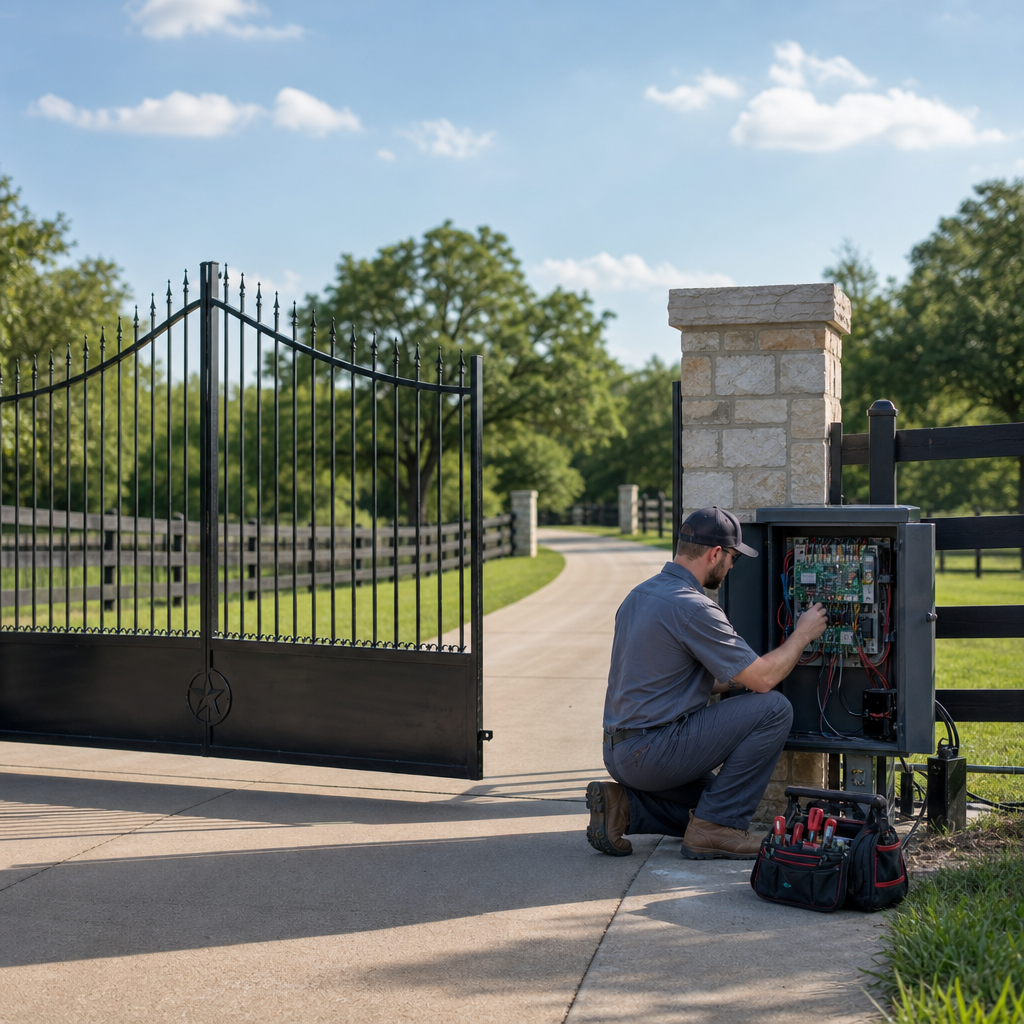
Control boards monitor the amperage draw of the motor. When mechanical drag spikes, the board reads that resistance as an obstruction and shuts down on an amperage-trip cutoff.
Diagnosing Soil Heave and Post Deflection
Heavy clay soils swell during wet seasons and shrink during dry spells, applying pressure to below-ground concrete footings. If a hinge post leans, the gate geometry shifts out of square:
- On swing gates, post deflection causes the hinge pins to bind, increasing the physical effort required to swing the leaf.
- On sliding gates, ground movement can lift or dip the track, causing the bottom rollers to pinch or the gate frame to rub against guide rollers.
Testing Manual Resistance and Travel Stops
- Disengage the drive arm or chain using the manufacturer release key while the gate is stationary.
- Move the gate through its complete travel path by hand to check for smooth operation.
- If you feel grinding, catching, or distinct heavy spots, technicians from Ironworks Gate Co. recommend greasing the hinge bearings, cleaning debris from the sliding track, or adjusting hinge collars to restore level alignment.
- Check your physical travel limits. From 1990 through 2024, 47 work-related accidents in California resulted from fence gates derailing and falling; 35 workers were injured and 12 died. Verify that appropriate end stops or positive stops are present and functioning, and consult applicable local requirements.
Step 5: Diagnose Motor Hum, Capacitors, and Control Boards
Need electric gate troubleshooting?
We’re available now - call for a fast, free estimate.
Warning: Electrical diagnostics, capacitor replacement, control-board work, and high-voltage wiring should be performed only by qualified professionals in accordance with the operator manual.
If you trigger your gate and hear the motor humming or clicking without any gate movement, the issue usually sits inside the operator drive assembly or the starting circuit.
Testing the Gate Motor Capacitor
Single-phase AC gate motors rely on a run capacitor to provide starting torque. When a capacitor fails or degrades:
- The motor will hum loudly before tripping the internal thermal overload.
- The motor housing may become hot to the touch.
- With the operator disengaged, the gate leaf moves freely by hand, confirming the mechanical hinges are not seized.
Operator Diagnostic Summary
| Symptom | Probable Root Cause | Diagnostic Action |
|---|---|---|
| Motor hums, gate does not move | Failed run capacitor or seized gearbox | Have a qualified professional test capacitor; check manual drive disconnect. |
| Gate opens, then stops and reverses immediately | Photocell misalignment or beam blockage | Clean lenses, align sender/receiver heads, check wiring. |
| Gate stops halfway across cycle | Amperage trip from hinge binding or track sag | Release clutch while stationary and check manual balance and post plumb. |
| No response, no lights on control board | Tripped GFCI, blown board fuse, power supply issue | Have a qualified professional test primary incoming AC voltage and check fuses. |
Control Board and Fuse Checks
With main power turned off, a qualified professional can inspect the control board. Check low-voltage glass fuses with a multimeter continuity test. Look for scorch marks, signs of water ingress around conduit entries, or insect damage on the back of the circuit board.
Step 6: Safely Switch to Manual Mode During an Outage
Knowing how to open an electric gate without power is essential during storms, power outages, or hardware failures.
- Keep People Clear: Keep people clear of the gate path and operating components.
- Switch Off Power: Switch off the controller and remove batteries if applicable so the operator cannot power up unexpectedly.
- Use Release Key or Handle: Use the manufacturer-supplied release key or handle and follow the specific manual.
- Disengage While Stationary: Disengage the drive only while the gate is stationary.
- Move and Latch the Gate: Move the gate slowly by hand and secure the leaf firmly in place using a manual cane bolt, drop rod, or chain.
When to Call a Professional vs. DIY Repair
While clearing track obstructions, cleaning photo-eye lenses, replacing remote batteries, and lubricating grease zerks are safe for property owners, the team at Ironworks Gate Co. notes that other repairs require specialized technicians.
Warning: Electrical diagnostics, capacitor replacement, control-board work, and high-voltage wiring should be performed only by qualified professionals in accordance with the operator manual.
Leave These Tasks to a Professional:
- High-Voltage Line Wiring: Diagnosing incoming power feeds or running underground conduit.
- Capacitor Replacement and Board Diagnostics: Testing and replacing high-voltage capacitors, fuses, and internal control boards.
- Structural Realignment: Resetting deep concrete hinge footings that have shifted in reactive soils.
- Heavy Spring and Chain Adjustments: High-tension counterbalance springs on overhead or cantilever gates carry severe crush and cut hazards.
- Internal Control Board Replacements: Wiring monitored safety circuits and configuring loop detectors.
Frequently Asked Questions
Why is my electric gate not responding to the remote or keypad?
Check simple components first: replace the clicker battery and verify the antenna wire is intact. If neither the remote nor the hardwired keypad works, check for a tripped GFCI outlet, a blown control board fuse, or an insect nest shorting the low-voltage terminal strip.
Why does my automatic gate open partially and then stop or reverse?
Possible causes include blocked, misaligned, unpowered, or faulty safety devices. In addition, mechanical resistance from shifting posts, track binding, or worn hardware can trigger the operator obstruction detection system, causing the gate to stop or reverse.
What causes an electric gate motor to hum or click without moving?
A humming motor that cannot move the gate may indicate a faulty motor run capacitor, low battery voltage on a solar system, or a mechanically seized gearbox. If the gate moves freely by hand when disengaged, the capacitor or starting winding may require professional service.
How do I clean and align electric gate safety photocell sensors?
Wipe the optical cover with a damp microfiber cloth to remove dirt, mud, and cobwebs. Remove the cover to verify no insects or moisture have entered the enclosure. Loosen the mounting bracket and adjust the angle until the onboard LED indicator confirms proper alignment according to the manufacturer manual.
Why does my gate open on its own without anyone pressing a button?
Ghost cycling can be caused by a shorted wire in an underground exit loop detector, moisture inside an external keypad, or external radio frequency interference.
Need electric gate troubleshooting?
We’re available now - call for a fast, free estimate.
Sources
- [PDF] Petition File No. 605 Cal/OSHA Evaluation – dir.ca.gov (2024)
- [PDF] 2024-11-20-COPF-CODD-Hummingbird-Alliance-Meeting-Log.pdf – cpsc.gov (2024)
- New Safety Standard for Automatic Security Gates Helps … – cpsc.gov (2000)
- [PDF] Investigation Guideline Product: Automatic Gate Operators Appendix – reginfo.gov (2000)
Related reading: Residential Gate Entry Systems – Call Now-10% Off – Same-Day Service – Free Estimate
Related reading: Community Gate Access Control | 10% Off & Free Estimate | Same-Day Service
Related reading: Gate Access Control Systems – Call Now-10% Off – Same-Day Service – Free Estimate
Frequently Asked Questions
What causes an automatic gate to drag or bind after seasonal weather changes?
Expansive clay soils frequently shift during heavy rain or severe drought, causing gate posts to deflect and throwing hinges or sliding tracks out of plumb. When mechanical drag increases, the control board senses the resistance as an obstruction and halts gate travel. Ironworks Gate Co. can perform an on-site structural assessment to realign shifted post geometry and prevent motor strain.
Why does my electric gate operator keep tripping the GFCI breaker repeatedly?
Recurring GFCI trips are typically caused by moisture ingress inside high-voltage conduit, damaged underground power feeds, or insect nests shorting terminal blocks. Because diagnosing high-voltage outdoor wiring presents serious shock hazards, Ironworks Gate Co. provides same-day emergency troubleshooting to safely isolate grounding faults.
Why is replacing an electric gate motor capacitor dangerous for DIY repair?
Gate motor run capacitors store high-voltage electrical charges even after main power is disconnected from the unit. Mishandling a charged capacitor can result in severe shock or arc flash injuries. Technicians from Ironworks Gate Co. use specialized diagnostic meters to safely discharge, test, and replace degraded starting components.
About the author
 |
Marcus Henderson Marcus Henderson is an access control specialist with over 10 years of experience in the automated gate industry. He previously worked as a field technician, diagnosing and repairing complex gate systems across North Texas, and now consults on residential and commercial security solutions. Marcus holds an associate degree in electronics technology from Tarrant County College. |
Gate not opening, off track, or opener dead?
We’re available now - call for a fast, free estimate.
Call Now - Free Estimate