
Last updated August 25, 2026
Free on-site gate assessment - hinges, posts, and your LiftMaster or Nice gate operator checked before anything is quoted
The assessment is free and the quote is the invoice.
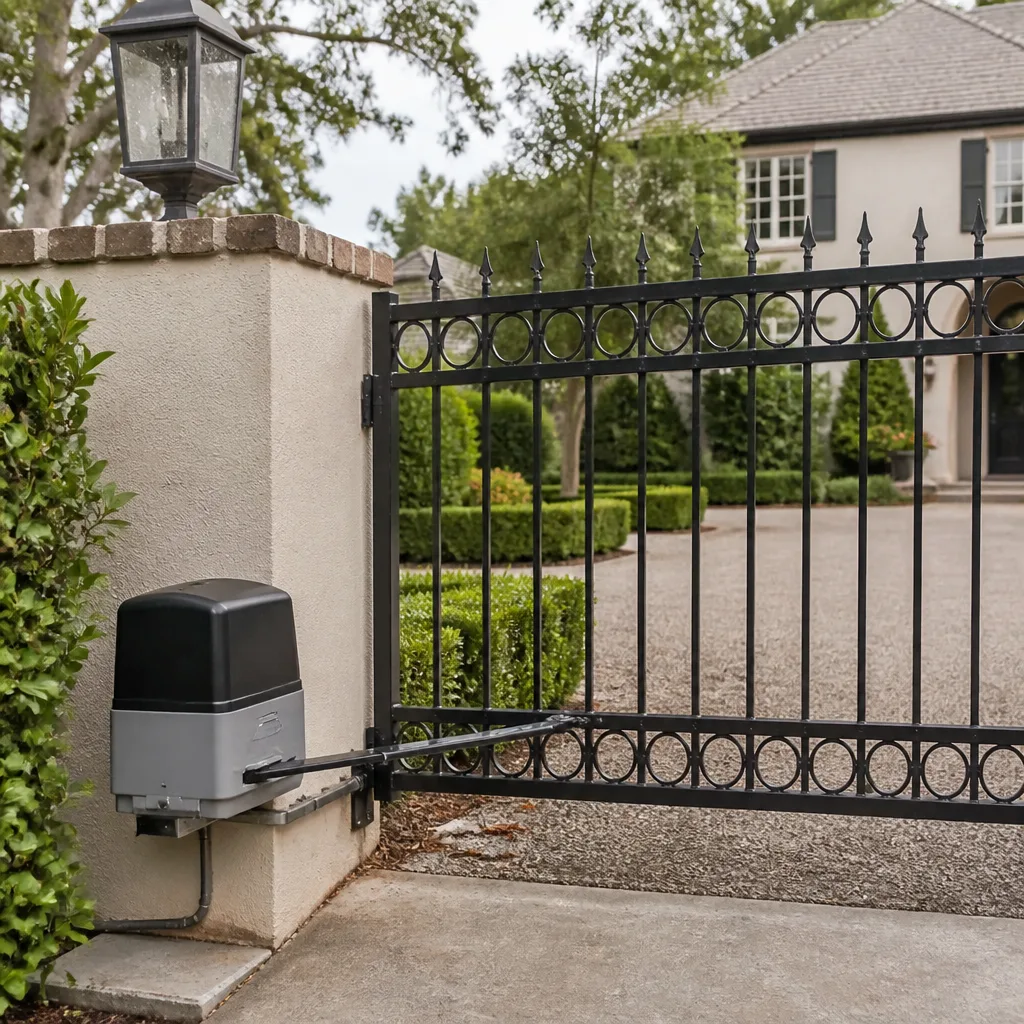
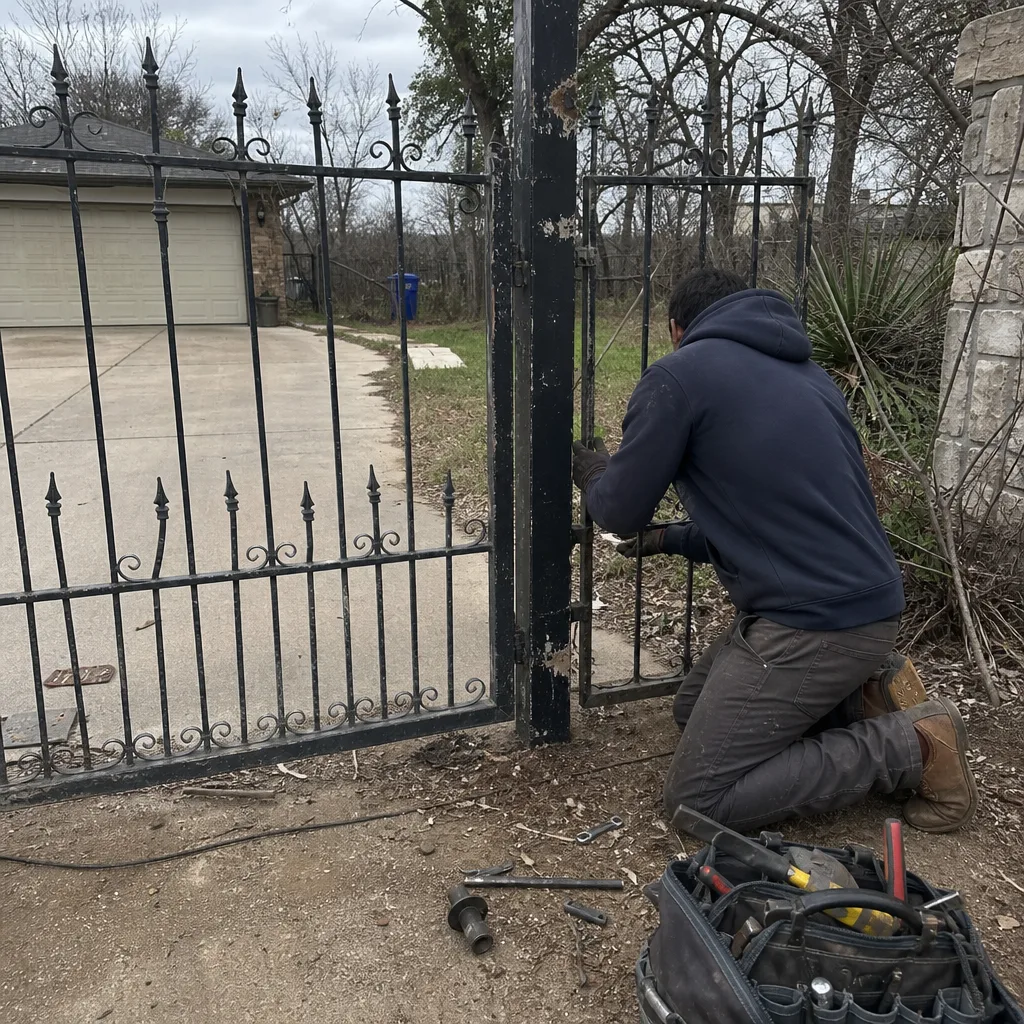 Before
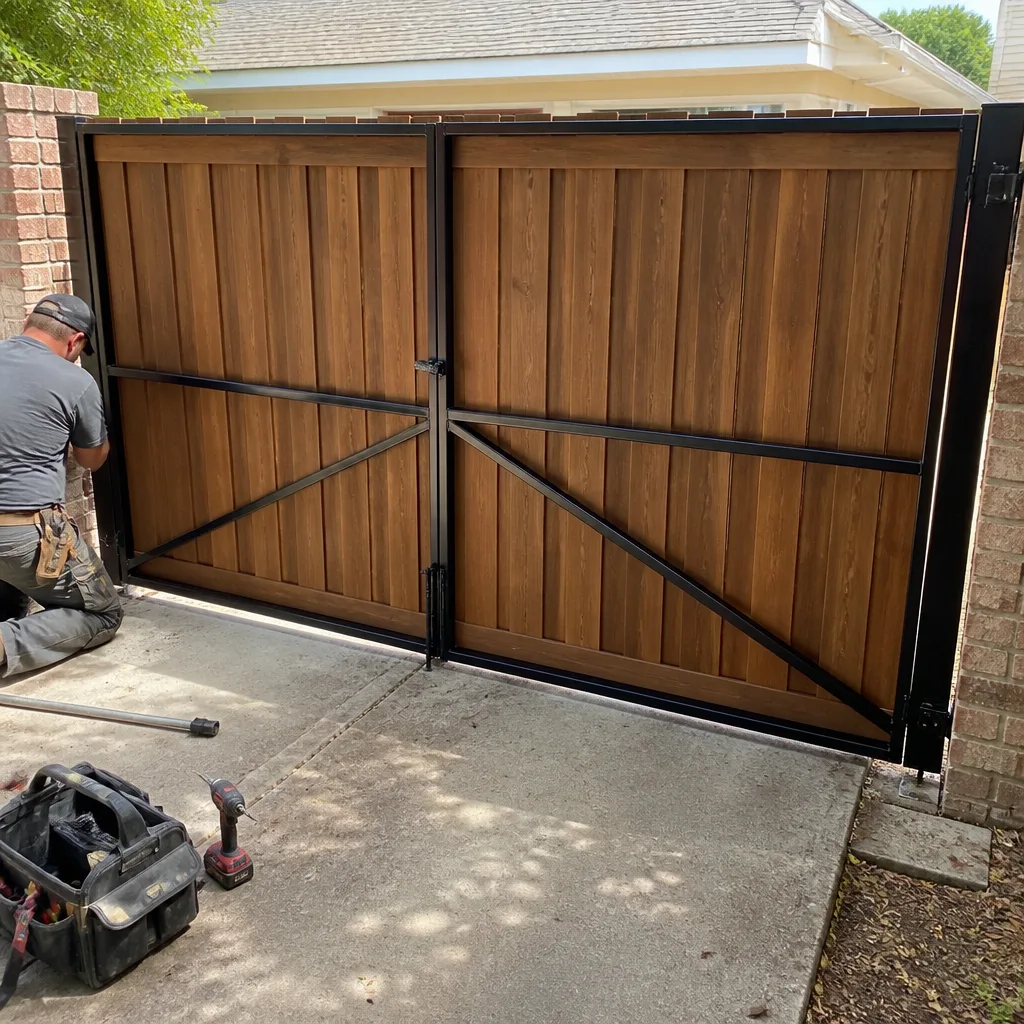 After
After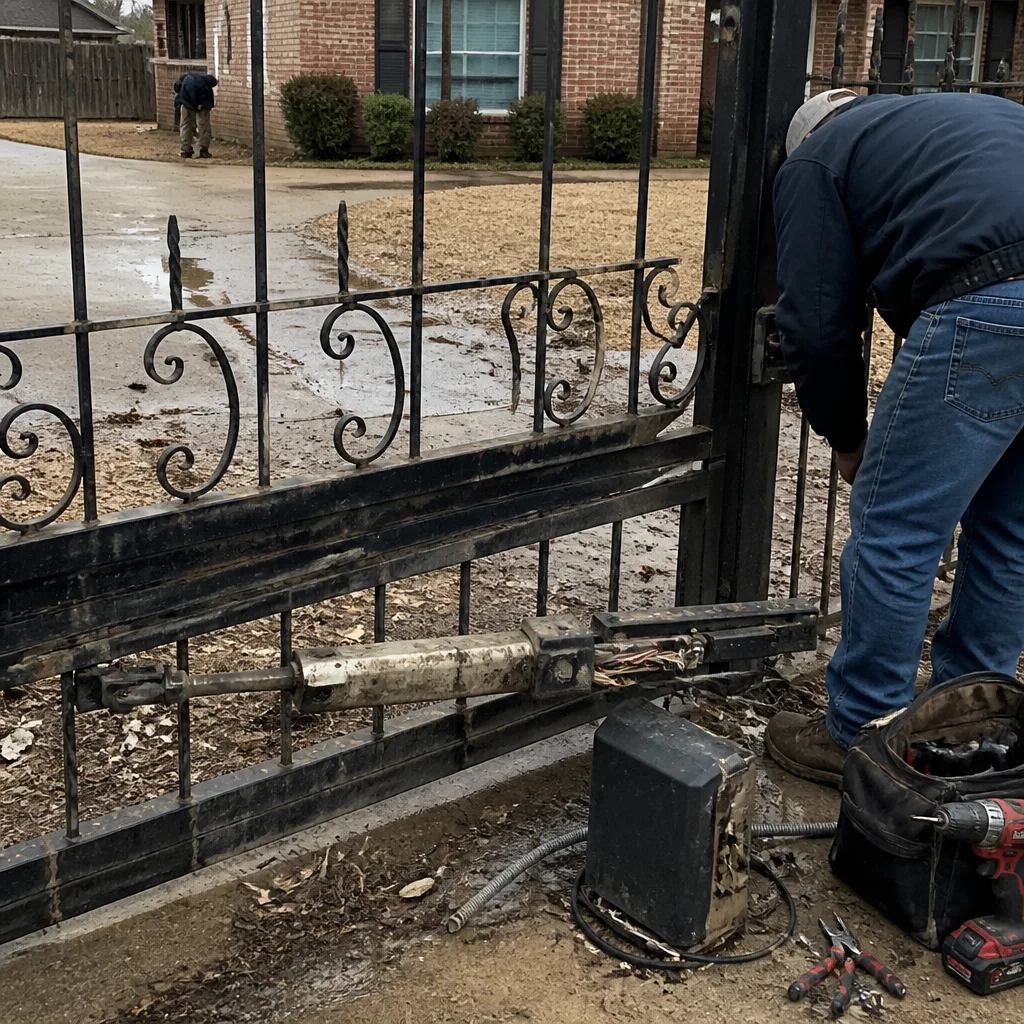 Before
 After
After Before
 After
AfterGate Repair Warning Signs: A Cleburne Homeowner’s Reference Guide
Most Cleburne homeowners don’t think about their driveway gate until the morning it refuses to open. But here’s what surprises people: gates almost never fail without warning. They telegraph trouble for weeks, sometimes months, through small sounds and small movements that get dismissed as “just the way it’s always been.” This guide walks you through the warning signs that matter, what they mean, how much they typically cost to address in Cleburne, and which ones you should never ignore. By the time you finish reading, you’ll know the difference between a $35 hinge adjustment and a $1,800 operator replacement before you spend a dime.
Quick Answer
The most common gate repair warning signs are a gate that sags or scrapes the ground, grinding or clicking noises from the motor, slow or jerky movement, a gate that reverses or stops mid-cycle, and keypad or remote entry that works intermittently. In Cleburne, most of these issues cost between $95 and $450 to repair when caught early, but can escalate to $1,200 to $2,800 if the operator burns out or a hinge tears off the post. If your gate is making a new noise or moving differently than it did last month, call a gate specialist before the failure strands your vehicle on the wrong side of the driveway.
Table of Contents
- A Gate That Sags or Scrapes the Ground
- Grinding, Clicking, or Whining Noises From the Motor
- Slow, Jerky, or Hesitant Gate Movement
- A Gate That Reverses or Stops Mid-Cycle
- Keypad and Remote Entry That Works Intermittently
- Rust, Weld Cracks, and Metal Fatigue on the Gate Frame
- How Cleburne’s Climate Accelerates Gate Wear
- Common Mistakes to Avoid
- When to Call a Professional
- Frequently Asked Questions
- The Bottom Line
A Gate That Sags or Scrapes the Ground
A sagging gate is the most common repair call we take in Cleburne, and it’s also the one homeowners wait on longest. The gate starts by dragging slightly at the latch end, then gradually worsens until you’re lifting the gate by hand just to swing it closed. What’s actually happening underneath is simple: the hinges were sized for the gate’s original weight, and time plus gravity plus a few thousand open-and-close cycles have pulled them out of alignment.
On steel tube-frame gates like most in Johnson County, sagging usually traces to one of three causes: hinge lag bolts pulling loose from the post, a hinge pin wearing down from friction, or the gate frame itself flexing because a weld has started to fail. If the gate post is a 4×4 wood post set in concrete, the post itself may be rotting underground and tilting with the weight. We see that regularly in older Cleburne neighborhoods where posts were installed thirty or forty years ago without proper drainage.
Cost-wise, a hinge adjustment in Cleburne typically runs $85 to $180 if the hinges are still sound. Replacing a pair of heavy-duty hinges runs $150 to $350, depending on gate weight and whether the post needs reinforcing. If the post itself has rotted or shifted, a new steel post set in fresh concrete costs $400 to $900 installed. The expensive version is what happens when nobody addresses it: the gate eventually rips the hinges out of the post entirely, and the repair becomes a full re-hang plus possible frame straightening at $600 to $1,200.
What to check this week
Stand at the latch end of your closed gate and look at the gap between the gate bottom and the ground. A healthy gate has a consistent gap from hinge to latch. If the latch end is noticeably lower, you’ve got sag. Then open the gate halfway and push gently up and down on the latch end. Play in the hinge of more than a quarter inch is a sign the bushings or pins are worn. Neither of these checks requires any tools, and neither puts you in danger.
Grinding, Clicking, or Whining Noises From the Motor
Your gate opener should sound the way it did the day it was installed: a low, steady hum with an even rhythm. A grinding noise means the drive gear inside the operator is stripping or the chain or belt is rubbing against the housing. A sharp clicking usually means a limit switch is failing or the operator’s internal gears are skipping teeth. A high-pitched whine that gets louder over time often points to a failing capacitor or a motor bearing that’s running dry.
The problem with these noises is that they often continue for weeks while the gate still works. The motor is straining harder on every cycle, generating more heat, and wearing itself out faster. By the time the gate stops moving, the fix is a full operator replacement rather than a gear or capacitor repair.
In our experience across Cleburne driveways, a grinding noise that’s caught early can often be fixed for $120 to $300 with a gear kit or chain tension adjustment. A burned-out operator replacement, by contrast, starts around $850 for a basic swing arm and runs to $2,800 or more for a heavy slide gate operator in Cleburne’s larger estate properties. The sooner you call, the cheaper the answer.
Safety note: a gate motor under load is not a DIY project. The capacitor inside a gate operator stores an electrical charge even with the power disconnected, and a wrong move can deliver a serious shock. Grinding and clicking are diagnosis jobs for a trained technician. The same goes for chain and belt systems tensioned under load: released incorrectly, they can break bones. If your motor is making a new noise, call a professional with the right training and tools.
Slow, Jerky, or Hesitant Gate Movement
When a gate that used to open in eight seconds starts taking fifteen or moving in uneven bursts, something has changed in the system. The usual suspects are a weakening capacitor, low voltage at the operator caused by a long or undersized wire run, a wheel or roller that’s seized on the track, or a hinge that’s binding as the gate swings. Sometimes it’s simpler than that: tree roots have shifted the track, or the concrete pad has settled and the gate now drags for the first few feet of travel.
Hesitant movement that’s intermittent is often electrical, not mechanical. A bad connection in a junction box, a photoelectric safety sensor that’s dirty or misaligned, or a battery backup that’s failing can all make the gate pause mid-travel. Intermittent problems are the most frustrating for homeowners, and the most important to catch because they can strand you outside your property at the worst possible time.
A typical slow-movement diagnosis and fix in Cleburne runs $95 to $250 when it’s a sensor alignment or capacitor replacement. A seized roller or wheel replacement runs $75 to $150 per roller. The fuller track repairs, where the track has shifted and needs to be relevelled and re-anchored, run $300 to $700. The key point is that slowness is cheaper to fix while the gate still moves at all. Once it stops completely, the options narrow and the price climbs.
A Gate That Reverses or Stops Mid-Cycle
A gate that starts opening, then reverses and closes again, or stops halfway and refuses to continue, is usually the safety system doing its job incorrectly. Driveway gate openers are equipped with obstruction detection, photo-eye sensors, and force settings that tell the operator to stop or reverse when it senses something in the gate’s path. When those sensors get dirty, misaligned, or when the force settings drift out of calibration, the gate behaves as if it’s hitting an obstruction every time, even when the path is clear.
Other causes include a failing limit switch, which tells the operator where the gate is in its travel, a worn gear in the operator that slips under load, or a low-voltage condition that drops power to the motor mid-travel. In Cleburne’s summer heat, we also see thermal overload protection kick in on older operators: the motor gets too hot, shuts down mid-cycle to protect itself, and works again once it cools. Homeowners often describe this as a gate that “works in the morning but not in the afternoon.”
Sensor cleaning and realignment is a $75 to $150 service call. Replacing a limit switch runs $95 to $200. If the operator itself is overheating and tripping its own protections, that’s usually a sign it’s near the end of its life, and a replacement is the honest recommendation rather than another patch. We’ll always tell you which situation you’re in before quoting the work.
Keypad and Remote Entry That Works Intermittently
Intermittent entry is one of the most annoying failures because it never happens on a schedule. The remote works in the morning, fails at noon, works again at night. The keypad accepts the code sometimes and beeps angrily other times. Homeowners understandably blame the remote or the keypad, and they sometimes replace those parts on their own before realizing the problem lives elsewhere.
Here’s what we find on Cleburne service calls more often than not: the receiver board inside the operator is failing, and its sensitivity has dropped. Or the antenna wire, which runs inside the operator housing, has come loose or been pinched. Or the keypad’s wiring junction has corroded from humidity and rain exposure. Remote controls themselves rarely fail without a dead battery, and keypad buttons can go out, but the larger failure usually sits at the operator or the wiring.
Diagnosing intermittent signal issues takes a technician with the right meter and a known-good test remote. Fixes range from a $35 battery replacement to a $120 to $300 receiver board replacement, depending on the opener brand. Keypad replacement runs $150 to $350 installed. And for homes using older dip-switch remotes, upgraded rolling-code remotes improve both reliability and security, though that’s a separate conversation about your access control setup around the property.
Rust, Weld Cracks, and Metal Fatigue on the Gate Frame
Rust is a reality in North Texas, and Cleburne’s humidity plus seasonal rain makes it worse for steel gates that aren’t painted and maintained regularly. Surface rust is ugly but usually cosmetic. The rust that matters is the rust at the bottom rail of the gate frame, at the weld joints, and around any drilled holes for latches or hardware. That’s where water pools, oxidation eats through from the inside, and the gate’s structural integrity quietly disappears.
Weld cracks are the second major frame issue, and they almost always appear at the joint between the horizontal rails and the vertical stiles, or where the hinge plate attaches to the gate. A hairline crack in a weld is the gate telling you the metal has been flexing under load. Left uncorrected, the crack propagates, the gate twists, and the whole panel loses its square. By the time it’s visibly bent, a gate that could have been re-welded for $150 to $300 needs to be un-hung, straightened, re-welded, and re-hung for $500 to $900, or replaced outright.
In Cleburne, we weld gates most weeks, and the economics are straightforward: catch a crack early, and it’s a same-day repair. Wait until the frame twists, and the same gate costs three times as much to put right. If you see orange staining under a flaking paint patch, or a crack that’s wider than a hairline, get it looked at before the next big wind. A gate that falls on a car, a child, or a pet is not a hypothetical in a town where sudden gust fronts are normal.
How Cleburne’s Climate Accelerates Gate Wear
Cleburne’s weather does specific things to driveway gates, and understanding those things homes in the speed of your maintenance decisions. The Johnson County heat, which regularly runs into the high 90s from June through September, expands steel gate frames and pushes operators to their thermal limits. The freeze-thaw cycles in winter, when temperatures swing from the 20s at night to the 60s in the afternoon, work on concrete pads and post footings the way a crowbar works on a door frame: slowly, steadily, and with measurable force each cycle.
The clay soil under Cleburne contributes its own movement. Johnson County sits on expansive clay that swells when wet and shrinks when dry. That movement shifts gate posts, tilts gate tracks, and changes the alignment between the gate and its latch over the course of a single season. A gate that latched cleanly in April can be misaligned by August, not because anything broke, but because the ground moved under it.
What this means practically: a seasonal inspection catches these shifts before they become repairs. The $89 tune-up we offer includes checking hinge alignment, operator force settings, safety sensors, and wheel or roller condition, all of which drift with the seasons. Homeowners who get that tune-up once a year rarely pay for a surprise gate failure at 7:00 a.m. on a workday. Homeowners who skip it often do, and the call usually starts with “it worked fine yesterday.”
Common Mistakes to Avoid
- Lubricating a gate to fix a grinding noise. Grease on a gate hinge solves a squeak, but it masks the grinding of a failing drive gear inside the operator. By the time the grease stops hiding the sound, the gear is destroyed. A grinding noise is a mechanical failure in progress, not a maintenance item.
- Replacing remotes and keypads before checking the receiver. We’ve lost count of Cleburne homeowners who bought new remotes on their own, programmed them, and still had intermittent entry because the receiver board inside the operator was failing. New remotes don’t fix a bad receiver, and you’ve spent the money twice.
- Adjusting hinge bolts without checking the post. Tightening the lag bolts on a sagging gate feels like a fix, and it works for about two weeks. Then the bolts pull out further because the post wood is rotted underneath. The post must be checked before any hinge work matters.
- Ignoring a slow gate because it still opens. A gate that moves slower every month is a motor working harder every cycle. Every week of “it still opens” is heat and wear on the operator, and the replacement cost is three to five times the repair cost that would have caught it.
- Powering through a gate that’s reversed mid-cycle. If the gate stops and reverses, something in the safety system is triggering. Holding the remote button and forcing the gate through the cycle is a fast way to strip gears, burn out the motor, and turn a $100 sensor fix into an $850 operator replacement.
- Painting over rust without treating the metal. Paint over active rust looks fine for one season and then flakes off, leaving the same rust plus a new layer of trapped moisture. Rust on a gate frame needs to be ground down, treated, and primed before paint, or the rot continues underneath.
- Assuming every gate needs a full replacement. We regularly see gates that were quoted for replacement by a handyman, but the actual issue was a $250 hinge and weld repair. A specialist can tell the difference in one visit.
When to Call a Professional
Call a gate specialist the day you notice a new noise, a new movement pattern, or visible rust at the welds. Don’t wait until the gate stops working, because the repair options narrow sharply at that point and the cost jumps with them. Also call immediately if the gate has started to move on its own, if a child or pet can slip through the gap at the hinge side, or if the gate has fallen against a fence or a vehicle. A sagging gate is a weight of several hundred pounds, and every week it remains unstable is a week it can fall on someone. Ironworks Gate Co. offers free estimates in Cleburne, and we’ll tell you honestly whether the fix is $100 or whether the gate has genuinely reached the end of its service life. Call (817) 961-9404 and a live person answers, at any hour.
Frequently Asked Questions
Gate repair in Cleburne typically costs between $95 and $450 for common issues like hinge adjustments, sensor realignment, capacitor replacement, and keypad repairs. Full operator replacement runs $850 to $2,800 depending on gate size and opener brand. Post replacement or gate re-hanging runs $400 to $1,200. Every price we quote is settled before work begins, so the number you approve is the number you pay. Call (817) 961-9404 for a specific quote on your gate.
A sagging gate can almost always be fixed, and replacement is rarely necessary unless the frame itself is rusted through or severely twisted. The fix usually involves new hinges, possibly a welded reinforcement plate, and occasionally a new post if the original has rotted or shifted. In our experience in Cleburne, eight of every ten sagging gates are repaired without replacement. A free estimate will tell you which path applies to your gate.
Intermittent gate operation is usually caused by a failing receiver board, a loose or corroded antenna connection, a dirty or misaligned safety sensor, or a capacitor that’s losing its ability to hold a charge. Heat can also play a role in Cleburne’s summer, where older operators overheat and shut down temporarily. These problems respond well to professional diagnosis, and most intermittent failures are fixed in a single visit.
We’re trained and equipped on nine major gate automation brands: LiftMaster, FAAC, BFT, Linear, Viking, Ghost Controls, DoorKing, Elite, and Mighty Mule. That means a technician arrives with the right part knowledge and diagnostic approach for whatever brand is on your driveway, including BFT’s hydraulic operators, Linear’s commercial controllers, Viking’s heavy slide operators, and Ghost Controls’ residential swing arms. Most jobs are completed in one visit.
Yes. We provide free estimates for all gate repair work in Cleburne and the surrounding Johnson County area. Estimates are written and the price is agreed before any work starts. We also offer a free second opinion on any written estimate from another company if you’d like a comparison before deciding. Call (817) 961-9404 to schedule one.
A well-built steel gate with proper hinges and regular maintenance lasts 15 to 25 years in Cleburne’s climate, while the opener typically lasts 10 to 15 years before needing replacement. Gates without maintenance, or gates with rust at the welds, often fail structurally in 8 to 12 years. The difference is almost always maintenance and early repairs, not the quality of the original installation. Our $89 seasonal tune-up is designed to keep your gate in the long-lasting category.
The Bottom Line
Your gate will tell you when it needs help. A sag, a grind, a hesitation, a reversed cycle: these are warning signals, not surprises. The homeowner who listens and calls early pays $100 to $300 for a repair that keeps the gate running for years. The homeowner who waits pays $850 to $2,800 for a replacement that could have been avoided. In Cleburne, with our heat, our clay soil, and our wind, the smart move is a seasonal check and a fast call when something changes. That’s how you get another twenty years out of a gate, and how you avoid the morning it stops opening at all. For a free estimate, call (817) 961-9404. Done right, and backed in writing.
Written by Victor Salinas, Owner at Ironworks Gate Co., serving Cleburne since 2013.