
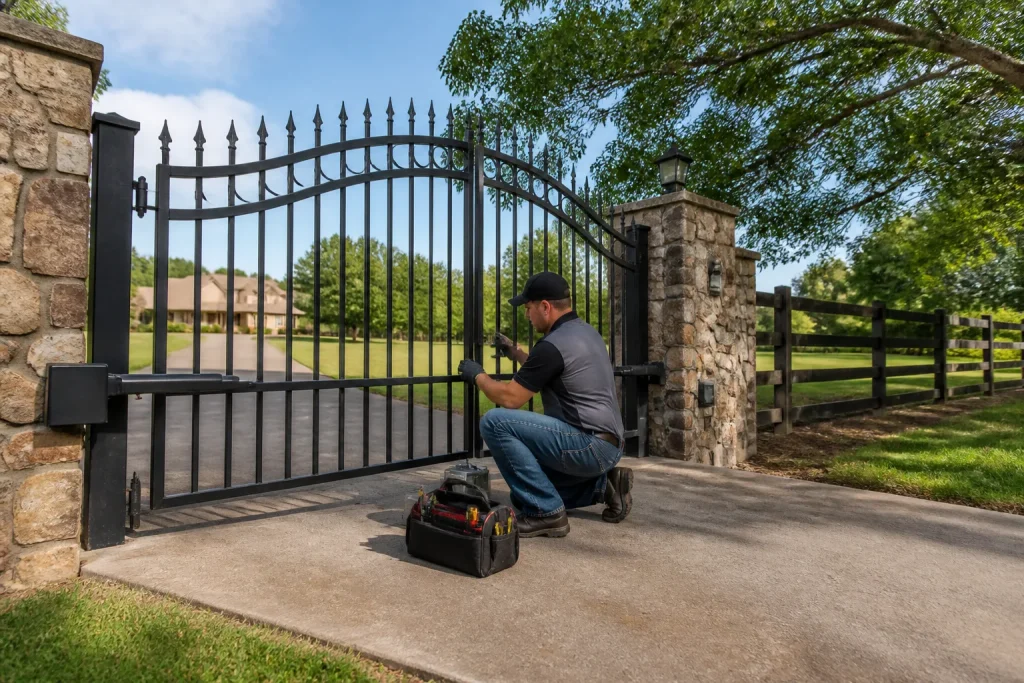
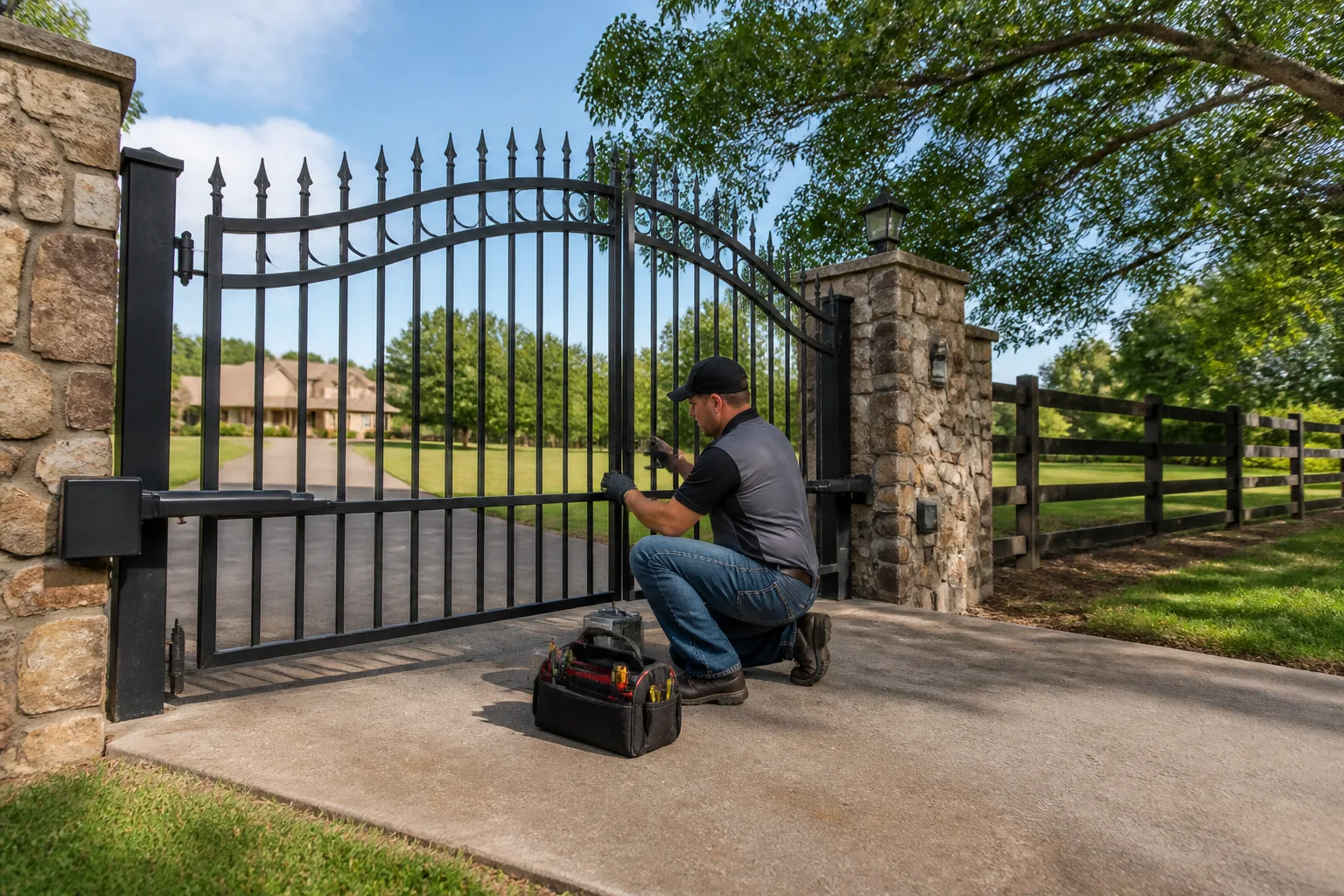
Elite Gate Repair in Cleburne: A Homeowner’s Guide
Elite gate repair in Cleburne means fixing the failure at its root, not just making the gate move again. A proper repair addresses the metal fatigue, the motor strain, or the foundation shift that caused the problem, then stands behind the work in writing. Most Cleburne homeowners we meet have paid for the same gate problem twice because the first shop patched the symptom. If you’d rather skip the trial and error, call us at (817) 961-9404 and we’ll diagnose it properly the first time.
A gate that opens and closes after a repair isn’t necessarily a gate that was fixed. It may just be postponing the same failure by six months. That distinction matters, because on a driveway gate, a delayed failure isn’t an inconvenience. It’s a four-hundred-pound slab of iron that quits halfway across the track at 6:40 on a Tuesday morning, with your car on the wrong side of it.
What “Elite” Repair Actually Means on a Wrought Iron Gate
Most gate repair in Cleburne falls into two categories: patch work and structural work. The difference is the difference between a gate that lasts six months and a gate that lasts fifteen years.
A patch repair addresses what you can see. A cracked picket gets welded at the surface. A sagging gate gets a shim under the hinge post. The gate opens. Everybody’s happy. Then the heat of July expands the metal, the crack reopens just past the weld, and the sag returns because the hinge post was never the problem. The concrete footer underneath it was.
A structural repair in Cleburne starts with the question of why. Why did that picket crack there? Nine times out of ten, it’s because the gate frame is carrying weight it was never designed to carry, or because the foundation under the post has shifted. North Texas soil doesn’t sit still. Cleburne sits on caliche and clay that swell with spring rain and contract through August. A gate post set in a shallow footer will move a quarter inch a year, every year, and that movement telegraphs up through the frame until something cracks.
When we weld a stress fracture on an iron gate, the weld itself is only half the job. The other half is finding what stressed it. That might mean re-hanging the gate to distribute weight evenly, rebuilding a hinge post that’s drifted, or adding a mid-rail support so the frame quits flexing. Otherwise you’re welding a crack closed while the force that opened it is still pushing.
- Patch repair: welds the visible crack, shims the sag, oils the roller. Gate moves again. Root cause remains.
- Structural repair: finds the force behind the failure, corrects it, then repairs the damage. Gate stays fixed.
- Cleburne factor: caliche soil movement and heat cycling mean post foundations and frame flex are the usual root causes here, not the visible crack.
How Cleburne’s Climate Creates Gate Problems Other Places Don’t Have
If you’ve lived in Cleburne for twenty years, you’ve watched the ground move. You’ve seen the crack in the sidewalk widen after a wet spring. You’ve watched fence posts lean a little more each August. Your gate sits in that same ground, and it feels every inch of that movement.
The failure pattern we see most often in Cleburne isn’t a broken motor or a snapped hinge. It’s a gate that slowly, gradually binds. The latch doesn’t line up the way it used to. The opener strains a little harder each month. One day the gate won’t close all the way and the safety sensor reverses it back open. The homeowner calls a handyman, the handyman adjusts the sensor, and the gate works for three weeks. Then the post shifts another fraction of an inch and it binds again.
The sensor wasn’t the problem. The post was. A technician who works Cleburne soil every day knows to check the post foundation before touching the opener. That’s what we mean when we say we diagnose the cause, not the symptom.
Heat cycling does its own damage. A black iron gate in full Cleburne sun can reach 140 degrees on a July afternoon. At night it drops to 80. That’s a sixty-degree swing, every day, for four months. Metal expands and contracts. Welds fatigue. Powder coat cracks at the stress points. A gate built with proper thermal gaps and welded joints that allow for expansion will shrug this off for decades. A gate welded rigid with no give will crack at the weakest joint, usually within five to seven years.
Why Certified Automation Expertise Saves You Money
Here’s a scenario we see constantly in Cleburne: a homeowner’s LiftMaster opener quits. They call a generalist who replaces the control board. A month later it quits again. They replace the motor. It still won’t hold. Finally someone checks the gate itself and finds the hinge bearings are so worn the opener is dragging four hundred pounds instead of rolling it. The opener was never the root problem. It was working too hard and burning itself out.
This is why brand certification matters, and why we train our technicians on nine opener brands instead of one. A technician who only knows Mighty Mule will replace Mighty Mule parts. A technician who knows Mighty Mule, LiftMaster, FAAC, and BFT knows what a healthy opener of each brand sounds like, draws like, and behaves like. They can tell the difference between a motor that’s failing and a motor that’s being overworked by an underlying gate problem.
In practice, that means fewer unnecessary part replacements. We don’t make money selling you control boards you don’t need. We make money fixing the gate once and having you call us in ten years for a tune-up instead of next spring for the same repair.
A quick way to test whether a company actually understands automation: ask them what brands they’re certified on. If they hesitate, or say “all of them” without naming any, that’s your answer. If they name three or more and can tell you what they see most often fail on each one, you’re talking to someone who diagnoses instead of guessing.
How to Read a Repair Estimate Like a Tradesman
Every estimate tells you how the company thinks. You just have to know what to look for. Here’s what separates a real repair estimate from a shortcut dressed up in professional language:
- Specific parts, not “gate hardware”: A real estimate names the hinge, the roller, the bracket, the board. “Gate hardware” means they haven’t looked at the gate yet or they don’t want you price-checking the parts. Either way, not a good sign.
- A line item for diagnosis: Good shops charge for the hour it takes to find the real problem. Shops that skip diagnosis are guessing, and you’ll pay for their guesses in repeat visits.
- Foundation or post work listed separately: If the estimate welds a crack but never mentions why the crack happened, the repair is incomplete. Ask the question: “What caused this, and how does this estimate fix the cause?”
- Warranty language in writing: If the guarantee is verbal, it doesn’t exist. We put our 90-Day Done Right Promise on every job in writing, no paperwork needed on your end. If something isn’t right, we come back and make it right. That’s the whole promise.
We pulled a gate out of a garage over in the Buffalo Creek area last month where the homeowner had two previous estimates. Both quoted “weld repair, bottom hinge area.” Neither mentioned that the bottom hinge post had pulled three-eighths of an inch out of plumb. The weld would have held for a season. Then the same crack would have opened six inches higher. We rebuilt the post base, re-hung the gate, and welded the crack. That gate will outlast the truck that pulls through it.
What a Written Workmanship Guarantee Should Actually Say
A guarantee is only as good as its conditions. Here’s what we’d want to see if we were hiring someone to work on our own gate:
The duration should cover weather cycles. A thirty-day guarantee on a weld is nearly worthless in Cleburne. If the weld survives thirty mild days but fails in the first July heat wave, you’re paying twice. Ninety days gets you through a full season of expansion and contraction. That’s why our Done Right Promise runs ninety days, not thirty.
It should cover labor, not just parts. A free replacement part is nice. But if you’re paying $150 in labor to install it, that’s not a guarantee, that’s a coupon. Ask the question directly: “If this fails inside your guarantee window, do I pay anything at all?” If the answer is anything but “no,” keep looking.
It should be in writing without you having to ask. We hand every customer the Done Right Promise with their invoice. It’s one paragraph. You don’t sign anything. You don’t register anything. If it’s not right, call us and we come back. No arguing, no paperwork, no exceptions. That’s the whole policy, and we’ve run the company on it for over 42 years.
When to Call a Pro
Some gate work is genuinely dangerous to attempt without training and proper equipment. A gate spring under tension can release with enough force to break a hand. A four-hundred-pound gate leaning out of plumb can pin someone against a post. The openers run on 110 or 220 volt power, and the high-tension springs and cables on certain opener types carry stored mechanical energy that doesn’t care how many YouTube videos you’ve watched.
Here’s our honest advice: if the problem involves a spring, a cable under tension, an opener wired to line voltage, or a gate that’s structurally sagging, call someone who does this every day. The cost of a professional repair is a fraction of the cost of a hospital visit, and it’s a lot smaller than the cost of replacing a gate that a well-meaning DIY repair tore clean off its hinges.
For related services in Cleburne, see our pages on Gate Motor & Opener repair and Gate Installation. If the gate itself is iron or steel and the problem is structural, our Gate Repair in Cleburne page covers that work in detail.
The Bottom Line
Elite gate repair in Cleburne isn’t about charging more. It’s about asking a better first question: why did this fail, and what stops it from failing again the same way. That question leads to post foundations, heat cycling, hinge bearing wear, and a dozen other causes that never show up in a surface-level estimate. It’s the difference between a gate that moves and a gate that stays fixed for the next fifteen years.
We’ve been doing this work since 1984, and we’re not going anywhere. Every job we do in Cleburne gets the same treatment: diagnosed properly, repaired at the root, and guaranteed in writing for ninety days. If your gate is acting up, call us at (817) 961-9404 for a free estimate. A live person answers, day or night. We’ll tell you honestly what’s wrong, what it costs to fix it right, and what it’ll take to never think about that gate again.
Learn more about who we are and how we work at our Ironworks Gate Co. home page.
Frequently Asked Questions
Gate repair in Cleburne typically runs $150 to $650 for most common fixes: hinge rebuilds, latch realignment, sensor replacement, and minor weld work. Motor and control board replacement usually falls between $450 and $900 depending on the brand. Structural repairs involving post foundations or frame work start around $400 and go up from there. Every quote we give is settled in writing before any work starts. Call (817) 961-9404 for an exact price on your gate, estimates are free.
Yes. Our technicians are local to Cleburne, not dispatched from Dallas or Fort Worth, so we can usually get to a repair the same day you call. The phone is answered by a live person 24 hours a day, 7 days a week. And for a gate stuck open or stuck closed, we treat that as a priority. Call (817) 961-9404 and we’ll give you a straight answer on when we can be there.
We’re trained and certified on nine major opener brands, including LiftMaster, Mighty Mule, FAAC, and BFT. That matters because each brand fails differently, and a technician who only knows one brand will often misdiagnose another. We diagnose the opener and the gate together, so we fix the real problem the first visit. Call (817) 961-9404 and tell us what’s on your driveway, we’ll tell you honestly what we can do.
Caliche and clay soil movement, plus extreme summer heat cycling. Cleburne ground expands and contracts with rain and drought, and that pushes gate posts out of alignment over time. Then the Texas heat expands the metal daily, fatiguing welds and stressing the frame. A gate built or repaired without accounting for these local conditions will fail early. A repair that addresses the foundation and the frame flex will outlast them. That’s the difference between a patch and a fix.
Written by Victor Salinas, Owner at Ironworks Gate Co., serving Cleburne since 2013.
Need Gate Repair Help?
Call Ironworks Gate Co. - licensed & insured, here with fast after-hours help in Cleburne.
(817) 961-9404