
Last updated August 25, 2026
Free on-site gate assessment - hinges, posts, and your LiftMaster or Nice gate operator checked before anything is quoted
The assessment is free and the quote is the invoice.
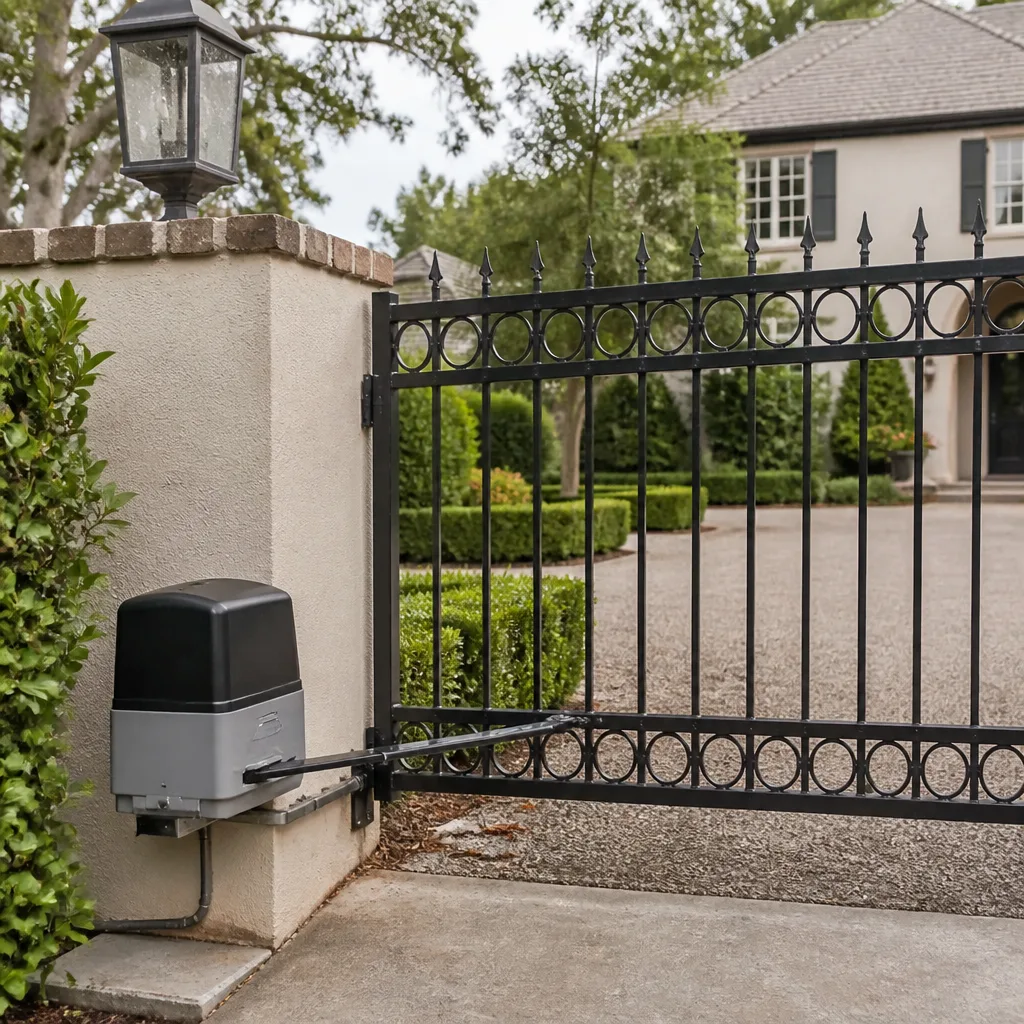
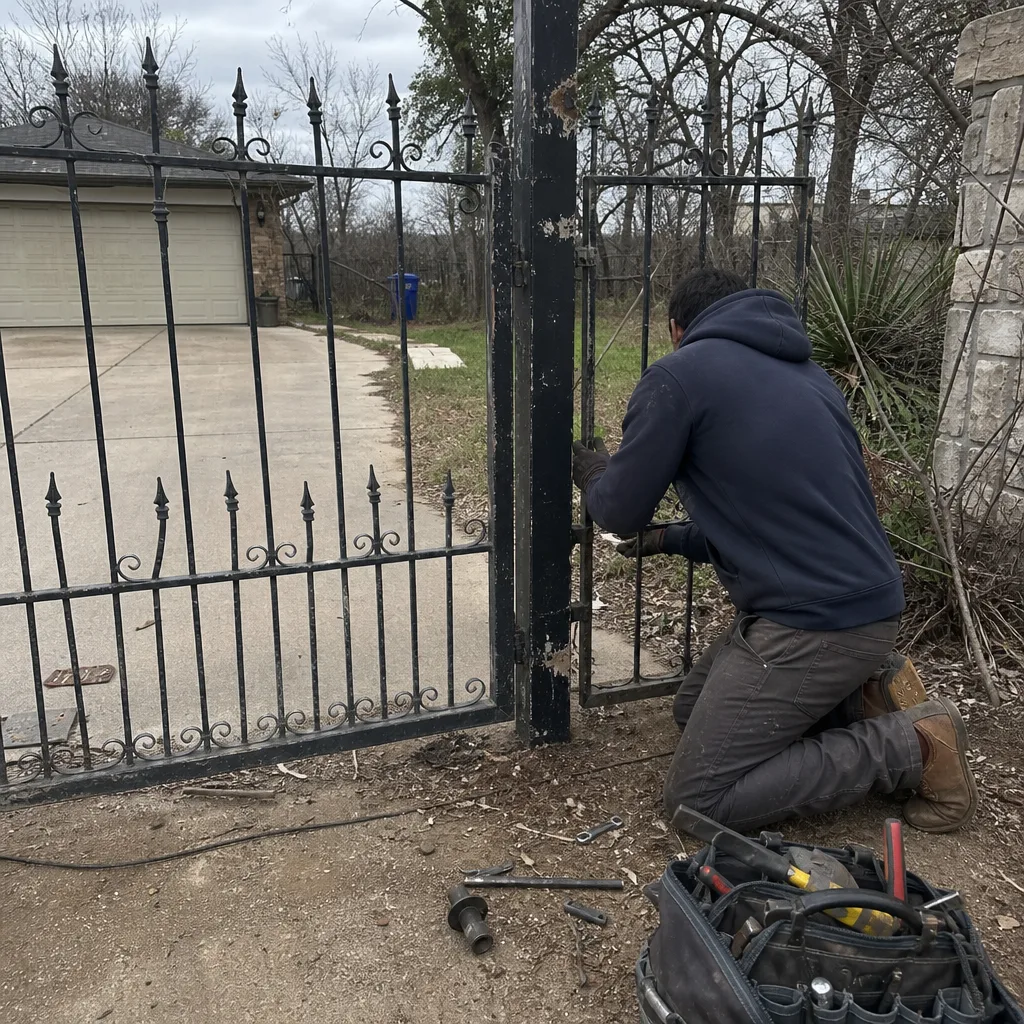 Before
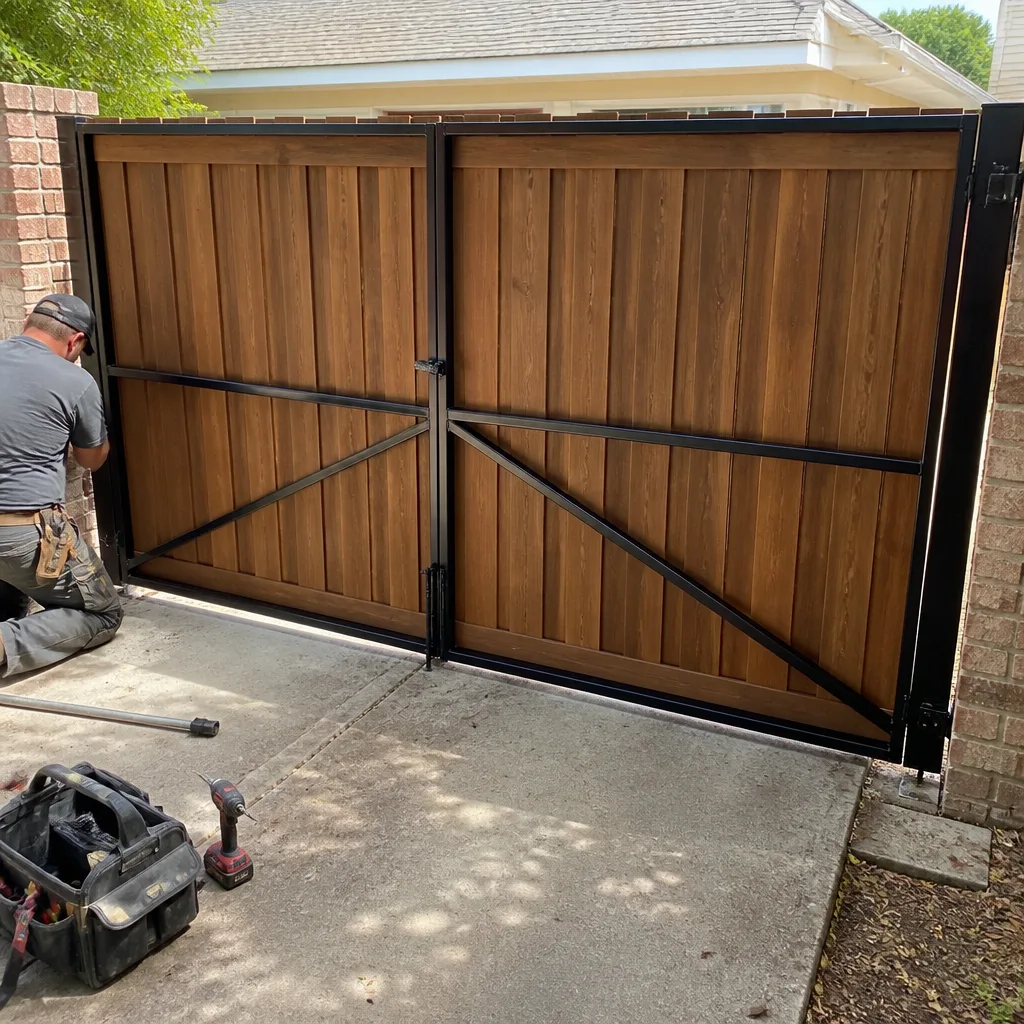 After
After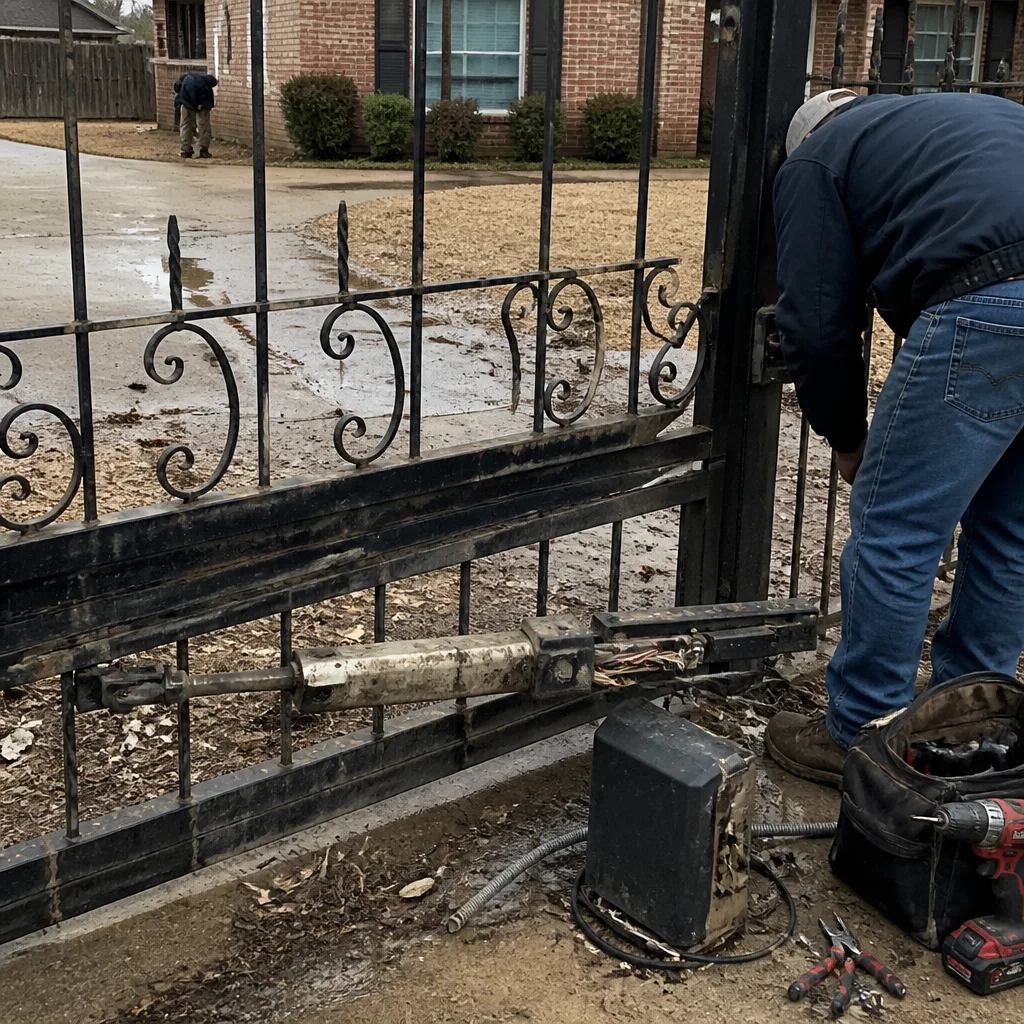 Before
 After
After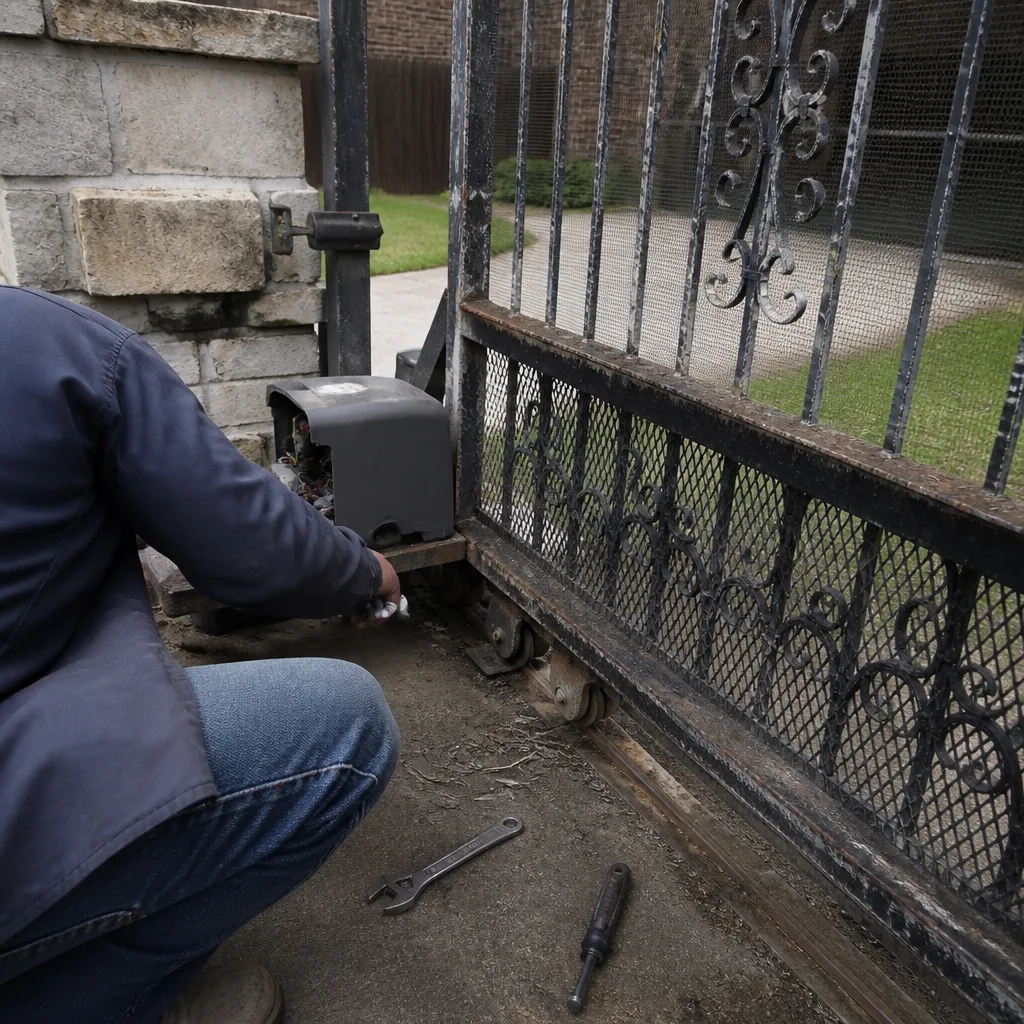 Before
 After
AfterDIY vs Professional Gate Repair: The Cleburne Homeowner’s Decision Guide
Here is a statistic that surprises most Cleburne homeowners: roughly one in four gate service calls we handle starts as a do-it-yourself repair that went sideways. The gate that would not close, the opener that hummed but did not move, the sagging leaf that dragged across the drive. Somebody watched a video, bought a part, spent a Saturday on it, and now the gate is in worse shape than when they started. This guide walks you through what is genuinely manageable on your own, what is not, what things cost in the Cleburne market, and how to know which side of the line you are standing on. By the end you will have a clear-eyed answer to the only question that matters: is this worth my weekend, or is this worth a phone call?
Quick Answer
Most cosmetic work and simple hardware swaps on a manual gate are realistic DIY projects, but anything involving torsion springs, welding, gate motors, or safety sensors is better left to a professional in Cleburne. The dividing line is not skill level, it is consequence: a mistake on a hinge is an annoyance; a mistake on a spring or a motor can tear up the gate, flatten a car, or injure a person.
Table of Contents
- What You Can Reasonably Fix Yourself
- What You Should Not Touch, and Why
- What DIY Really Costs in Cleburne
- What Professional Repair Actually Costs
- How to Tell Which Path You’re On: A Step-by-Step Triage
- The Cleburne Climate Factor
- When the Opener Is the Problem
- Common Mistakes to Avoid
- When to Call a Professional
- Frequently Asked Questions
- The Bottom Line
What You Can Reasonably Fix Yourself
Some gate work is genuinely within a competent homeowner’s reach. You do not need a welding rig or a certification to handle these, and most can be done in an afternoon with basic tools. We have seen plenty of Cleburne homeowners do clean work in this category, especially on older manual gates where the hardware is exposed and the mechanism is visible.
The honest list looks like this:
- Lubricating hinges, rollers, and the gate track. A can of lithium grease or white lithium spray, a rag, five minutes. This is the single most underrated maintenance task for any gate in Johnson County, where dust from dry spells works its way into pivot points.
- Replacing a bent or broken latch. Manual gate latches are generic in many cases, available at hardware stores, and mount with two or four bolts. If the gate itself is sound and only the latch fails, this is a legitimate DIY fix.
- Tightening loose hinge bolts. Over years of Texas wind, bolts back out. If the hinge plates are not cracked or wallowed out, tightening them with a socket wrench is safe and effective.
- Clearing debris from the track. Gravel, acorns, dirt clods, and wind-blown twigs accumulate in sliding gate tracks and cause jerkiness or stalling. Clearing the channel is safe, fast, and frequently solves the problem on its own.
- Repainting or treating surface rust on a manual gate. Wire-brush the affected area, apply a rust converter, prime, and repaint. This is preservation, not structural work, and homeowners can absolutely do it.
- Replacing a broken picket on a wood gate. If the frame is solid and only one or two pickets have split, a circular saw is overkill. Pull the old picket, cut a replacement to size, and screw it in.
Notice what all of these have in common: no stored energy, no electricity, no load-bearing structural failure. The gate is not going to fall on you while you change a latch. That is the clearest way to think about the DIY line. If a part is not under tension, not carrying the gate’s weight, and not plugged into anything, the risk is low.
Even within this list, read the gate first. A hinge that is loose because the bolt stripped is a different animal from a hinge that is loose because the post itself has rotted or shifted. In Cleburne, where clay soil expands and contracts with rain and drought, gate posts move over time. If the post is the problem, tightening bolts buys you a month, not a fix. That leads naturally into the next section.
What You Should Not Touch, and Why
Here is where we speak plainly, because a real gate company owes you that. There are repairs that present a genuine risk of serious injury, and we will not sugarcoat them. The most dangerous components on any gate system are the ones that store energy.
Torsion springs. A torsion spring on a gate or garage door holds hundreds of pounds of torque. When it lets go, it lets go instantly and without warning. The metal bar used to wind them can snap back hard enough to break a jaw or a wrist. This is the single highest-injury gate component, and no video online prepares you for what a spring under load actually does. In our experience, most homeowners do not own the correct winding bars, and improvising with screwdrivers or rebar is how people get hurt. This is not a lecture; it is the truth from people who have wound thousands of these.
Gate motor internals and capacitor replacement. A gate opener capacitor holds a charge even after the unit is unplugged. Touching the wrong terminals is a genuine shock hazard. Beyond that, opener control boards are not forgiving: one crossed wire and the board is dead. A replacement board runs several hundred dollars, which turns a $200 attempt into a $500 problem.
Any weld on a load-bearing gate frame. A gate leaf that weighs 300 to 800 pounds is not held together by goodwill. When a weld fails on a pickup point or a hinge mount, the gate sags, binds, or drops. Improvised repairs with angle iron and a borrowed stick welder sometimes hold and sometimes shear. If that weld fails while the opener is pulling, the gate can twist, jump the track, or fall. Welding is a skill, not a hack.
Safety sensor alignment and replacement under automation. Photo eyes and edge sensors are the difference between a gate that stops on a child and a gate that does not. Wiring them incorrectly or disabling them because they are “annoying” is how entrapment injuries happen. This component exists to make the gate safe, not just to make it work.
Hydraulic gate operators. Some estate gates in the Cleburne area run on hydraulic or electro-hydraulic operators, and these are a different species entirely. Pressurized fluid, accumulators, and specialized fittings. A pinhole leak can spray fluid under pressure. This is a certified-technician job, full stop.
If you take one sentence from this entire guide, take this one: anything with stored mechanical energy, stored electrical charge, or sustaining the weight of the gate is not a DIY job. The cost of being wrong is measured in fingers, eyesight, and worse.
What DIY Really Costs in Cleburne
The calculation most homeowners make on a DIY repair goes like this: the part costs $40, a handyman charges $250, so I save $210. But in the real world, the math is rarely that clean. We have sat across kitchen tables in Cleburne and walked through the hidden costs more times than we can count.
Here is what a DIY gate repair in Johnson County actually costs, line by line:
- The part itself. Springs, brackets, hinges, and sensors all have a retail price. You pay it once. But if you order the wrong spec, you pay it twice, plus return shipping, plus another week of waiting.
- Tools you do not own yet. A quality torque wrench, a set of winding bars, a multimeter that reads capacitor discharge, a welder rental. Most of these are one-use purchases for a homeowner. The winding bars alone for a torsion spring will run you $30 to $75, and you will never use them again.
- Your time, priced honestly. What is your Saturday worth? If the repair takes six hours, that is six hours you were not doing something else. Homeowners rarely factor their own labor into the savings math, and they should.
- The cost of the mistake. This is the line item that breaks the DIY budget. Strip a hinge bolt and the repair escalates. Cross a wire and the control board dies. Drill into a hollow post and compromise the structure. A $40 repair attempt that turns into a $600 professional repair is not theoretical; it is a phone call we take regularly.
- Safety margin, priced as insurance. You cannot put a dollar figure on a broken wrist or a crushed hand, but the ER copay alone can exceed the professional repair cost. In Cleburne, an emergency room visit for a laceration runs into the hundreds even with decent insurance.
None of this means “never do it yourself.” It means do the math with the hidden lines included. For a latch, a lube job, or a paint touch-up, the math favors doing it yourself. For a spring, a motor repair, or a weld, it does not, and it is not close. The reason is simple: the downside of a failed DIY repair on a light-duty cosmetic item is low. The downside of a failed DIY repair on a spring or motor is not just the cost of the repair; it is the cost of the damaged gate, the damaged opener, the damaged vehicle, and sometimes the damaged person.
What Professional Repair Actually Costs
Cleburne homeowners deserve to know what gate repair costs before they pick up the phone. Here are the honest ranges we see in this market, based on the type of repair and the scope of the problem. These are line-item ranges for the Cleburne area, not national averages from a website that has never been to Johnson County.
- Hinge replacement (single gate, standard duty): $125 to $275 per hinge, including parts and labor. Heavy wrought-iron hinges on an estate gate run higher.
- Track cleaning and alignment: $100 to $200. Simple, fast, and frequently prevents bigger problems.
- Torsion spring replacement: $180 to $340 per spring, including labor. Most gates have one or two springs.
- Opener control board replacement: $250 to $550, depending on brand. BFT and Linear boards tend to run toward the middle of that range; Viking boards can run higher.
- Safety sensor replacement and alignment: $125 to $250 per pair. This is a safety item; do not bypass it to save money.
- Full opener motor replacement (standard swing or slide) $900 to $2,400 installed, depending on the operator brand, gate weight, and whether the old mounting hardware can be reused. Ghost Controls units sit at the accessible end of that range.
- Welded crack repair on a steel gate frame: $150 to $450, depending on the location and length of the crack.
- Complete automated gate installation (new): $3,500 to $12,000, depending on gate type, size, opener brand, and access control. This is a different conversation from a repair, and it deserves its own visit and its own written quote.
One thing every Cleburne homeowner should know: the price you are quoted should be the price you pay. A reputable gate company settles the number before the work starts, in writing. If a quote changes after the gate is disassembled, that is not a change order; that is a bait and switch. At Ironworks Gate Co., the price is agreed before a single bolt is turned, and the customer approves it before we touch the gate. That is how a square deal works.
How to Tell Which Path You’re On: A Step-by-Step Triage
When a gate stops working correctly, the first reaction is usually frustration, followed by a vague hope that it will fix itself. It will not. Here is a simple, systematic way to triage the problem and decide whether you are reaching for a wrench or a phone. The goal is to get you to the right answer in under ten minutes.
- Stand at the gate and look at the whole thing. Is the leaf itself sagging? Is it dragging on the ground? Is the post leaning? If the gate is physically distorted or the post has moved, the problem is structural, not mechanical. That is a professional repair. A sagging gate means a hinge or post issue, and it will only get worse.
- Open and close the gate by hand. Disconnect the opener if you can do so without touching wiring. Does the gate move freely when pushed by hand? If yes, the mechanical side is probably fine and the problem is in the opener. If no, focus on what is binding: hinges, rollers, the track, or debris.
- Look for the obvious, visible, safe-to-fix issues. Check the track for debris. Check hinge bolts for looseness. If the gate is manual and the latch is broken, that is a clear DIY path. If everything visible looks fine but the gate still will not move correctly, do not start disassembling.
- Listen to the opener. Does it hum but not move? That is often a failed capacitor or a stripped gear. Does it click but do nothing? That can be a control board relay. Does it do nothing at all? Check the breaker, then check the battery if it has one. All three of these point to a professional repair, because they involve opening the motor housing.
- Check the safety sensors if the gate reverses or stalls. Are the photo eyes dirty, misaligned, or obstructed by a cobbweb or a vine? Cleaning and realigning them is safe if you do not touch the wiring. If they are clean and aligned and the gate still reverses, the sensor itself has failed and needs replacement by someone who knows the wiring.
- Make the call on the dividing line. If the problem is in the opener, the springs, the welds, or the structure, stop here and call a gate company. In Cleburne, that phone call will get you a live person and a straight answer. If the problem is a latch, a lube point, a track clog, or a loose bolt, you have a Saturday project.
This triage process works because it moves from the least invasive check to the most. You start by looking, then touching, then listening. At no point does it require you to put yourself under a spring, inside a motor, or on the receiving end of a grinder.
The Cleburne Climate Factor
Cleburne sits in a particular pocket of Texas weather, and gates here take a specific kind of beating. The summers are long and hot, with daytime highs above 100 degrees in July and August. The winters are mild but punctuated by hard freezes that arrive fast and leave ice hanging on gate hardware. The soil is the bigger story, though: Johnson County clay expands when wet and contracts when dry, and that movement does not stop at the fence line.
What that means for a gate is simple. Posts shift. Metal fatigues. Hardware that was true in March can be binding by August, not because anything broke but because the ground under the post moved. A gate that drags in the summer may swing fine in the winter, and vice versa. This is not a mystery; it is soil mechanics, and every Cleburne gate lives with it.
For the DIY decision, climate matters in three specific ways:
- Rust and corrosion happen faster here than in Dallas or Fort Worth. Cleburne gets more wind-driven rain and more prolonged humidity swings than the Metroplex proper. Hardware that looks lightly rusted on the surface may be structurally compromised underneath. A hinge bolt that snaps during removal is a classic sign.
- Thermal expansion plays havoc with metal gates. A black iron gate in direct Texas sun can hit 140 degrees on the surface. The metal expands, contracts, and over years, tolerances change. That is why a gate that closed fine for a decade suddenly starts sticking.
- Freeze-thaw cycles loosen everything. Even mild freezes work sealant joints and bond points. After a Cleburne winter, hinge plates that were solid in October can be loose in February. It is not negligence; it is physics.
If a homeowner in Cleburne calls us about a gate that is suddenly dragging or binding, our first questions are: has it rained recently, and how old is the gate. The answer to those two questions usually tells us more than a visual inspection. This is not generic gate advice; it is specific local knowledge earned from four decades of working in this soil.
When the Opener Is the Problem
Gate openers are where most homeowners get in over their heads. A gate opener is not a garage door opener bolted to a post; it is a specialized piece of equipment that has to account for wind load, gate weight, travel limits, and safety requirements that a garage door never faces. More than any other component, the opener is where a DIY attempt turns into a cascade of failures.
The reason is the control board. Modern gate openers run on microprocessors that manage limit switches, safety sensor inputs, battery backup, and communication with keypads and remotes. When a motor capacitor fails, a homeowner might reasonably think it is a swap like a car battery. It is not. The capacitor in a gate operator board is soldered into a circuit that also handles voltage regulation and relay logic. One bad solder joint, one wrong-value capacitor, and the board is dead. A replacement board for a BFT, Linear, or Viking unit in Cleburne runs between $250 and $550, and that is a cost that did not exist before the DIY attempt.
Ghost Controls is a common brand on residential gates in the Cleburne area, and its openers are generally homeowner-friendly in design. But even with a Ghost Controls unit, the wiring and the board layout are not intuitive for someone who has never opened one. The manufacturer’s manual assumes a level of familiarity that most homeowners do not have.
Here is the realistic math on opener repair: a capacitor is a $15 part. A control board is a $300 part. The difference between replacing the first and destroying the second is about two crossed wires. We are not being dramatic when we say that opener repair is the single most common source of “I tried it myself” calls we take in Cleburne. The conversation usually starts with the words, “It was working fine until I…”
If the opener is under warranty, the case for DIY is even weaker. Opening the housing on most units voids the warranty, and manufacturers are increasingly firm about this. A homeowner who opens the motor to “take a look” may have just converted a covered repair into a paying one. If the unit is less than five years old, check the warranty before you pick up a screwdriver.
Common Mistakes to Avoid
We have watched homeowners in Cleburne make the same mistakes for long enough to see the patterns clearly. Some of these cost money. Some cost time. A few cost more than either. Here is the short list, drawn from actual service calls in Johnson County.
- Lubricating a torsion spring with the wrong product. WD-40 is a solvent, not a lubricant. Spraying it on a gate spring displaces whatever grease was there and leaves the spring dry. Use white lithium grease or a dedicated spring lubricant, and never while the spring is under tension.
- Overtightening hinge bolts. A hinge needs to move. Cranking the bolt down until the gate binds creates more problems than it solves. If the gate is in the right position and the hinge still sticks, the hinge is worn, not loose.
- Disabling a safety sensor to “fix” a reversing gate. This is the one that keeps us up at night. A gate that reverses because the sensor detects an obstruction is working as designed. Bypassing the sensor to force the gate closed is not a repair; it is a safety violation. Every automated gate is required to have working entrapment protection, and this code requirement is enforced in Johnson County on new installations.
- Welding on a gate post that is not solid. If the post itself is rotted or rusted through from the inside, welding a brace to it does nothing. The post fails, and the whole gate comes down. Cleburne’s clay soil and rain cycles contribute directly to post rot in older installations.
- Buying a replacement part online without checking the gate’s brand and model. Gate hardware is less standardized than homeowners assume. A hinge for a 1990s steel gate is not interchangeable with a hinge for a modern aluminum one. If you cannot find the part number, call someone who can identify it by looking.
- Ignoring a gate that grinds, scrapes, or shudders because “it still works.” Gates do not heal. A grinding sound is metal removing metal. The longer it runs that way, the more expensive the eventual repair. A $150 hinge replacement ignored for a year becomes a $600 gate rebuild.
When to Call a Professional
Here is the clearest way to say it: call a professional when the gate is under tension, under power, under load, or under warranty. That covers torsion springs, opener internals, weld failures, structural post damage, and any automated gate safety component. It also covers any repair where the consequence of failure is not just an inconvenience but an injury.
If the gate is sagging, if the opener hums but does not move, if a spring is broken, if a sensor is out, if the post is leaning, or if you opened the motor housing and found something you do not recognize, stop and make the call. Ironworks Gate Co. offers free estimates in Cleburne; call (817) 961-9404 and a live person answers, day or night. We will tell you over the phone whether the job is worth a service visit, and the price is settled before we start. No surprises, no pressure, no games.
Frequently Asked Questions
Most gate repairs in Cleburne run between $125 and $550 depending on the component. A hinge replacement, a track cleaning, or a sensor swap sits at the low end; a control board or a torsion spring sits at the high end. Full opener replacements and welded structural repairs run higher. Get a written quote before work starts and make sure the number does not change. Call (817) 961-9404 for an exact quote; estimates are free.
No. Gate torsion springs hold hundreds of pounds of stored energy and can cause severe injury if they release during handling. The winding bars sold for this job are used by professionals who have wound thousands of these; an improvised bar is a recipe for a serious accident. This is the one repair where we tell every Cleburne homeowner, without exception, to call a professional.
When Cleburne’s clay soil absorbs rain, it expands and pushes gate posts slightly out of alignment. The gate leaf then sits lower in its travel arc and drags on the ground or track. If the dragging goes away after the soil dries, the post movement is seasonal. If it persists, the post has shifted permanently and needs to be reset or reinforced. Call (817) 961-9404 and we can tell you which one you are dealing with.
A complete gate opener installation in Cleburne includes the operator unit, mounting hardware, safety photo eyes, wireless receiver, and wiring from the control board to the motor and sensors. It also includes setting travel limits and force settings so the gate opens fully and stops without slamming. Power supply work, keypads, and access control are separate line items that should be quoted in writing before the job starts. Get a written estimate from a licensed gate company; do not pay for an opener install without one.
For most common opener failures, yes. A failed capacitor, a faulty sensor, or a misaligned track is often repairable in a single visit. More involved repairs like a control board replacement or a welded frame repair may require a follow-up if a part must be ordered. A live person answers the phone 24 hours a day at (817) 961-9404, and the visit time is set when you call.
That depends on the gate’s frame condition and what the repair involves. A well-built steel or iron gate with a rusted hinge is worth repairing. A gate with a rotted post, multiple failed welds, and a frame that is twisting under its own weight is probably at the end of its service life. A reputable gate company in Cleburne will tell you the truth about which you have, even if the answer is “replace it.” Call (817) 961-9404 and ask for an honest assessment.
The Bottom Line
DIY gate repair has a place, but that place is narrower than most homeowners first assume. Latch swaps, lube jobs, track cleaning, and picket replacement are fair game for a competent person with basic tools. Everything else, the springs, the openers, the welds, the structural work, belongs with someone who does this daily and carries the training to do it safely. In Cleburne, where the clay soil shifts and the summers bake the metal, the margin for error on a mechanical repair is thinner than it looks. Do the small stuff yourself if you enjoy it. For the rest, make one call, get a written price, and let the gate be the last thing you have to think about.
Written by Victor Salinas, Owner at Ironworks Gate Co., serving Cleburne since 2013.