
Last updated August 25, 2026
Free on-site gate assessment - hinges, posts, and your LiftMaster or Nice gate operator checked before anything is quoted
The assessment is free and the quote is the invoice.
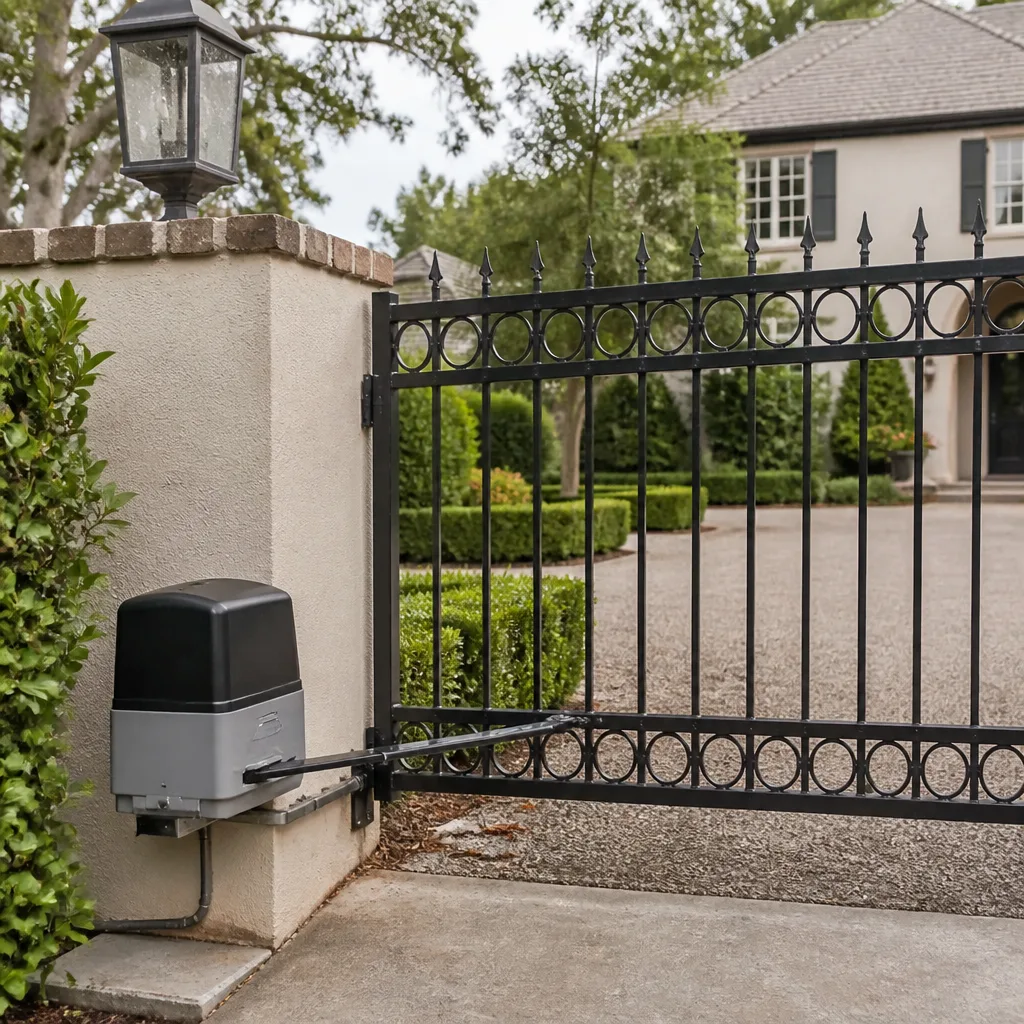
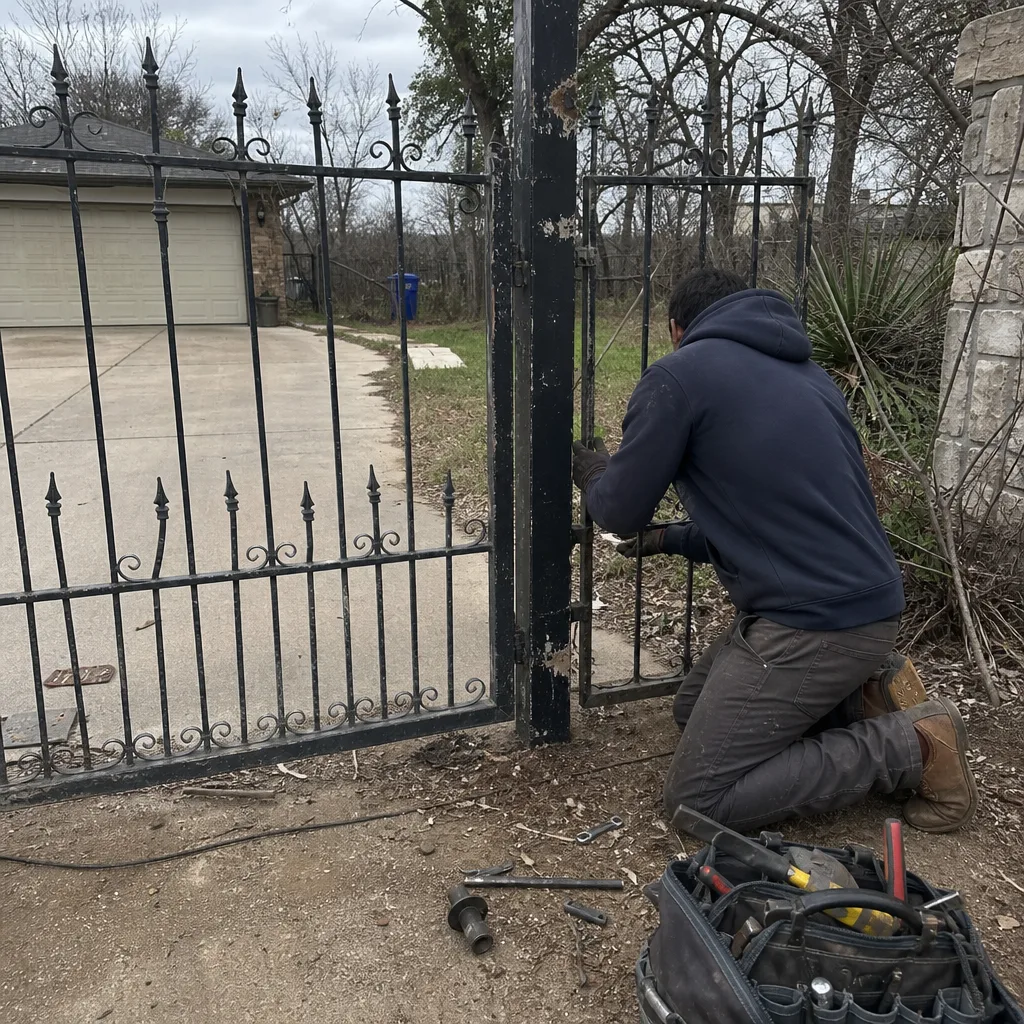 Before
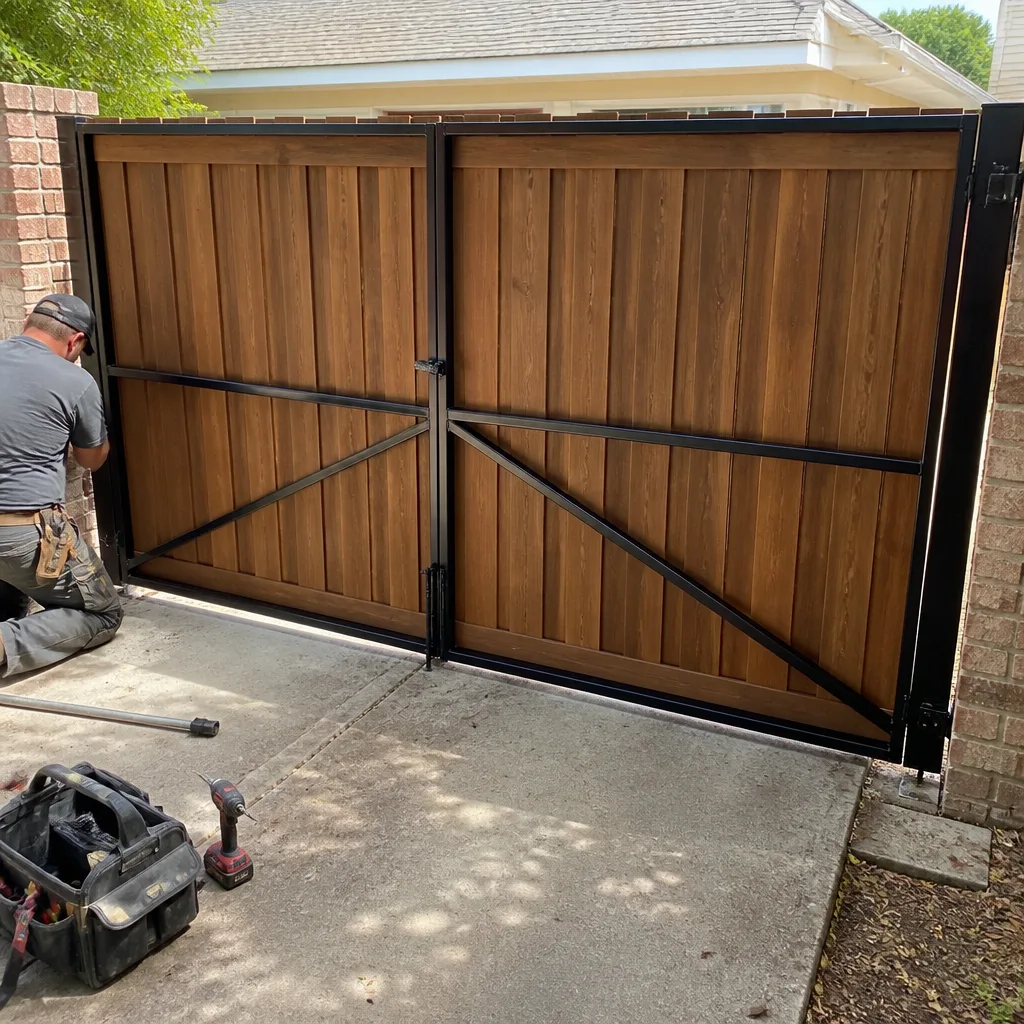 After
After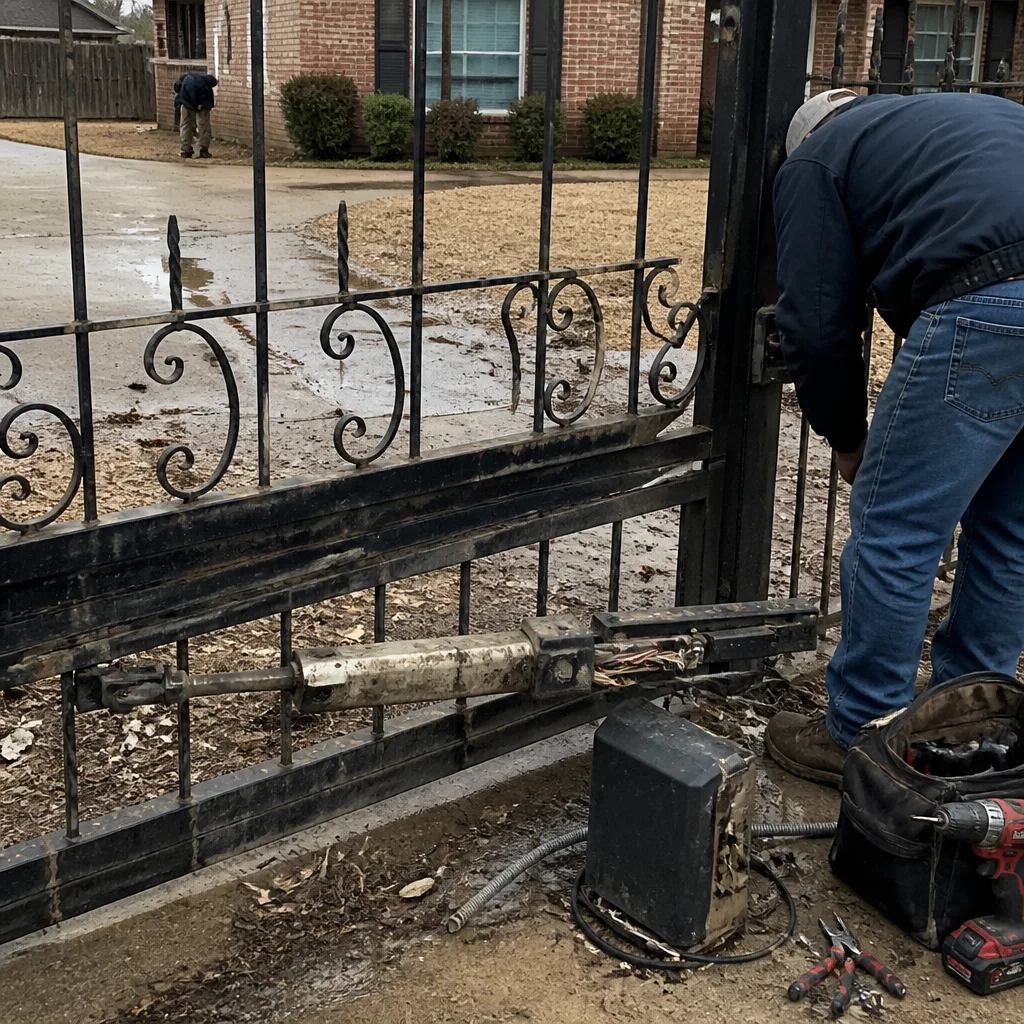 Before
 After
After Before
 After
AfterSeasonal Gate Repair Care for Cleburne: Year-Round Homeowner’s Guide
Most driveway gates in Johnson County fail during the two weeks when the temperature swings hardest. Not the hottest day of July, not the coldest morning of January. The transition weeks. A cast-iron hinge that has held for thirty years will crack when Cleburne goes from 85 degrees at noon to 38 degrees by midnight, because metal expands and contracts and eventually says no. This guide is written for the homeowner who wants to catch that hinge before it cracks. We’ll walk through what each season does to a gate in Cleburne, what to check yourself, what to leave alone, and what a seasonal tune-up should actually include.
Quick Answer
Cleburne homeowners should inspect and maintain their driveway gate four times a year, with the most critical checks in early spring and late fall when temperature swings put the most stress on metal hinges, welds, and motor gears. A proper seasonal routine takes about 30 minutes per season and prevents roughly 80% of the emergency repairs we see. The non-negotiables are hinge lubrication, track cleaning, limit-switch testing, and tightening every visible bolt on the gate leaf and post brackets.
Table of Contents
- Why Cleburne Weather Is Hard on Gates
- Spring Care: Recovering from Winter
- Summer Care: Heat, Dust, and Johnson County Wind
- Fall Care: The Critical Prep Season
- Winter Care: Cold Snaps and What They Break
- The 10-Minute Monthly Gate Check
- What a Proper Seasonal Tune-Up Includes
- Common Mistakes to Avoid
- When to Call a Professional
- Frequently Asked Questions
- The Bottom Line
Why Cleburne Weather Is Hard on Gates
Cleburne sits in a climate band that punishes outdoor metal more than most of North Texas. The combination of high summer heat, periodic drought, sudden cold fronts, and the spring hail season creates a specific set of stressors that a gate in, say, Houston or Fort Worth does not experience in the same way. We have pulled gates out of older Cleburne neighborhoods near North Nolan River Road and seen rust patterns that would take a decade to form in a coastal climate, purely because the dry heat strips protective coatings and then a single rainy March exposes bare steel.
The soil matters too. Cleburne has significant clay content in its soil, and clay moves. A gate post set in clay soil will shift over years of wet-dry cycles, and a shifted post means a gate leaf that drags, a latch that no longer aligns, and a motor that works harder every cycle until the board gives out. This is not a manufacturing flaw. It is local geology doing what local geology does.
For homeowners in established neighborhoods around Hulen Park, North Cleburne, or the older streets near the Chisholm Trail Parkway corridor, the age of the gate installation matters as much as the weather. Many gates in Cleburne were originally hung in the 1990s and early 2000s, which means the original posts, hinges, and underground conduit are now 20 to 30 years old. A seasonal care routine is not optional maintenance on a gate of that age. It is the difference between a $89 tune-up and a $1,800 gate motor replacement.
Spring Care: Recovering from Winter
Spring in Cleburne is a wake-up call for gate hardware. The ground is wet from March and April rains, the clay around posts has expanded, and any moisture that found its way into hinge pins or bearing surfaces over the winter has had months to set up rust. The first warm days are when homeowners notice the gate has started to sag, scrape, or stall.
Here is the spring checklist we recommend to every homeowner in Cleburne:
- Inspect the gate leaf for sag. Open the gate halfway and look at the gap between the latch side of the gate leaf and the post. If the gap is wider at the top than the bottom, the gate is sagging and the hinges or post are shifting. A sagging gate will eventually drag on the ground and burn out the motor.
- Clean the track, if you have a sliding gate. Johnson County clay and gravel fill slide tracks quickly after spring rains. Use a flat shovel or stiff broom to clear debris, then run water through the track to remove packed silt. A track that is half full of mud makes the motor pull double amperage.
- Lubricate hinge pins and bearing surfaces. Use a penetrating lubricant, not heavy grease. Grease collects dust and turns into grinding paste by June. Two or three drops on each hinge pin twice a year is sufficient.
- Check the gate opener’s force settings. After winter temperature swings, limit switches drift and force settings fall out of spec. If the gate reverses for no reason or stops six inches short of the close position, it is almost always a limit or force adjustment issue, not a bad motor.
- Test the safety sensors and the auto-reverse function. Place an object in the gate’s path during closing. The gate should reverse immediately. If it does not, stop using the automatic function until it is serviced. A gate that does not auto-reverse is a serious safety hazard, particularly in neighborhoods with children or pets.
We have worked on gates across Cleburne, from the acreage properties east of Lake Pat Cleburne to the tight driveway layouts in the older in-town lots near the courthouse square. Spring failures look different depending on the installation. On acreage gates with long runs of underground wire, spring is when rodents and root growth damage the low-voltage control wiring. On in-town swing gates, spring is when post movement shows up for the first time. If your gate has started making a grinding noise in March or April, it will not self-correct. It will get louder.
Summer Care: Heat, Dust, and Johnson County Wind
Summer in Cleburne is a test of everything that gets hot and stays hot. Gate operators are rated for outdoor use, but sustained ambient temperatures above 95 degrees, with direct sun on a black control box and the reflected heat off a concrete driveway, push components to their thermal limit. The most common summer failures we see are capacitor blowouts in older Linear operators, thermal overload trips in Viking units, and circuit board failures in any brand when the control enclosure is in full afternoon sun.
The fix for heat problems is not a stronger motor. It is airflow and shade. Here is what matters in a Cleburne summer:
- Keep the control box shaded. If the operator housing or control enclosure faces west or southwest, it is absorbing the hottest sun of the day. A simple shade structure or relocating the enclosure to the shady side of the post can extend component life by years. If you cannot shade it, at minimum keep the vents clear and free of spider webs and dust caked by humidity.
- Watch the duty cycle. The hotter the day, the longer the motor needs to cool between cycles. A gate that cycles 40 times a day in July needs more cooldown than the same gate cycling 20 times in November. If your gate opener is still warm when you put your hand on the motor housing an hour after the last cycle, it is being overworked.
- Dust matters more than people think. The limestone and clay dust around Cleburne gets airborne in dry spells and settles into every moving part. Dust inside a gearbox mixes with gear grease and accelerates wear. Dust on a photo-eye sensor makes the gate refuse to close. Dust on the limit switch causes the gate to stop at the wrong position every third cycle. A compressed air blast to the operator housing and sensor lenses is a legitimate monthly summer chore.
One thing we tell every Cleburne homeowner with an automated gate: the operator is not the gate. The operator is an appliance attached to a heavy metal structure. In summer, the operator fails because it is fighting the gate itself. A gate that is hard to push by hand in July is killing the motor slowly. If you can push the gate open with one hand and it moves smoothly, the operator has an easy life. If it takes both hands and a grunt, the motor is doing that work every single cycle, in 100-degree heat, and it will not last.
Fall Care: The Critical Prep Season
If you only do one serious maintenance pass per year, do it in October or early November. Fall in Cleburne is the calm before the temperature swings that crack gates. This is the season to address anything you ignored all year, before the first hard fronts sweep down from the Panhandle.
The fall checklist is the most thorough one:
- Inspect every weld and hinge point visually. Look for hairline cracks in the welds where the gate frame connects to the hinge plates. Look for rust streaks running down from any bolt head. A crack that is invisible in October can become a snapped hinge plate in January when the metal contracts.
- Tighten every bolt on the gate leaf, hinge plates, post brackets, and operator mount. A surprising number of “motor failures” are just loose bolts causing vibration, misalignment, and excessive amp draw. Use a torque wrench if you have one. If a bolt keeps coming loose, the threads are worn and the hole needs to be re-tapped or a threaded insert installed.
- Address low spots under the gate’s swing path. Gravel driveways in Cleburne develop ruts during summer storms. If the gate leaf is dragging on a high spot, the bottom rail wears through the galvanizing and eventually through the steel. Fill and level gravel low spots before the gate eats through its own frame.
- Test the battery backup, if your opener has one. The battery in a BFT or Ghost Controls unit has a 2 to 4 year lifespan in our climate. If it has not been replaced in three years, replace it now. The battery is what keeps the gate working during the winter storms that knock out power in Johnson County.
- Run the gate through a full open and close cycle while watching and listening. Watch for hesitation at any point in the travel, listen for changes in pitch from the motor, and watch the gate leaf for any wobble or shake. If something looks or sounds different from the month before, that is the early warning system telling you to act before winter.
Fall is also the right time to schedule a proper seasonal tune-up, because the schedule is forgiving and the weather is cooperative. An $89 tune-up in October prevents a $400 emergency call in January. If your gate is two years past its last professional inspection, that is not a maintenance schedule. That is a gamble.
Winter Care: Cold Snaps and What They Break
Cleburne winters are not Minnesota winters, but they do not need to be to break gate hardware. The problem is not sustained deep cold. It is the rapid cycle of freeze and thaw, often within the same week, sometimes within the same day. Metal contracts when the temperature drops. Moisture inside a hinge pin or inside a gearbox freezes and expands. Then the sun comes out, the temperature climbs 40 degrees, and everything expands again. That repeated expansion and contraction is what kills gates in Johnson County, not any single cold morning.
What actually fails in a Cleburne cold snap:
- Cast-iron hinge plates and brackets. Cast iron is rigid and brittle compared to rolled steel. A cast-iron bracket that has been subtly cracked for years will let go during a cold snap when the gate leaf is trying to move against a stiff motor. This is a sudden failure and the gate usually drops onto the driveway.
- Limit and force adjustments drift in the cold. When temperatures drop, lubricants thicken, metal shrinks, and the motor’s torque characteristics change. A gate that closed perfectly in October may stop four inches short in February. It is usually not a failing motor. It is a limit switch that needs a seasonal adjustment.
- Low-voltage wiring and splices. Underground wire splices that were sealed years ago with cheap wire nuts and tape will eventually let in moisture. When that moisture freezes, it creates intermittent connection failures. The gate works, then does not, then works again. Those intermittent faults are the hardest to diagnose and often get misdiagnosed as bad circuit boards.
- Gearbox oil thickens. In cold weather, the grease or oil in the gearbox gets stiff. The motor draws more current to overcome the resistance. Older motors with marginal capacitors will fail to start on cold mornings. This is not a reason to replace the motor immediately. It is a reason to make sure the gearbox lubricant is clean and at the correct level going into winter.
One winter-specific piece of advice for Cleburne homeowners: never force a frozen gate open with the manual release handle. If the gate is frozen to the ground or the hinges are bound with ice, the manual release can shear or the chain can jump the sprocket. Use warm water only, never rock salt, directly on frozen hinges. Salt accelerates corrosion on gate hardware and will destroy the finish faster than anything else in a Texas winter.
The 10-Minute Monthly Gate Check
Between seasonal deep checks, a monthly 10-minute walk-around catches most developing problems before they become breakdowns. This is the same routine our technicians use when they inspect a gate in Cleburne, simplified for homeowners. None of these steps require tools beyond a flashlight and two hands.
- Push the gate manually through its full travel. It should move smoothly, with no binding, no grinding, and no spots where it feels heavier than others. If it does not glide with one hand, something is wrong.
- Look at the gap between the gate and the ground. It should be consistent across the full swing. A gap that narrows at the far end means the gate is sagging or the post is leaning.
- Check the hinge bolts and post brackets. Put a hand on each bolt and try to wiggle it. They should be tight. If you see rust streaks running from any bolt head, that bolt is loose and water has been getting in.
- Test the auto-reverse with a plastic trash can or traffic cone. Place it in the gate’s closing path. The gate must reverse on contact. This is a safety test, not a convenience test. In Cleburne neighborhoods with kids on bikes and golf carts, a working auto-reverse is not optional.
- Listen for changes in pitch or rhythm from the operator. A motor that sounds different from one month to the next is trying to tell you something. Whining, groaning, clicking, or hesitation all have specific meanings to a technician.
Log what you find. A simple note in a calendar or a photo on your phone creates a record, and that record is genuinely useful when a technician is trying to figure out whether a problem is new or has been developing for months.
What a Proper Seasonal Tune-Up Includes
There is a difference between what a homeowner can check and what a professional tune-up should cover. A proper seasonal tune-up goes beyond the visual and the tactile. It gets into the electronics, the adjustments, and the wear items that only a trained eye can evaluate. Here is what a seasonal gate tune-up in Cleburne should include whether you do it yourself or hire it out:
- Battery health test under load, not just a voltage reading. A battery that reads 12.4 volts at rest can drop to 9 volts under load and fail to open the gate during a power outage.
- Limit switch calibration on both the open and close ends of travel. Limits drift over time on every brand, from BFT to Ghost Controls, and the calibration should be re-checked at least twice a year.
- Force setting verification on both directions of travel. Force settings that are too high create a safety risk. Force settings that are too low cause nuisance reversals. The correct setting is a narrow band.
- Photo-eye and safety edge testing with simulated obstructions at different heights. Safety edges wear out, photo-eye lenses get clouded by sun exposure, and all of it should be verified working at every tune-up.
- Gearbox oil and grease inspection. Contaminated grease compacts and hardens, and the gears wear against it. Clean lubricant at the right level makes a measurable difference in motor life.
- Complete bolt and fastener torque pass, from the gate leaf to the operator mount to the post brackets. A torque pass catches loose hardware before it becomes structural failure.
- Wiring inspection at the operator, keypad, loop detector, and any exposed junction boxes. In Cleburne, sun damage to wire insulation is common. Cracked insulation means moisture intrusion, which means corrosion and intermittent failures.
Ironworks Gate Co. offers a standing $89 seasonal tune-up for Cleburne homeowners. The tune-up covers the full list above, and it includes an honest assessment of what the gate needs. If something is worn but not yet failing, we tell you. If nothing needs attention, we tell you that too. A square deal means no inventing problems to pad a bill.
Common Mistakes to Avoid
Most of the gate damage we repair in Cleburne was not caused by weather or bad luck. It was caused by one of these preventable mistakes:
- Skipping the visual inspection because the gate still works. Gates fail gradually, then suddenly. The visible signs of trouble (sag, rust streaks, soaked wiring, cracked welds) appear months before the breakdown. Ignoring them does not save money. It converts a $89 tune-up into an $800 repair.
- Using WD-40 or motor oil as a hinge lubricant. These products attract dust and wash away in rain. In Cleburne’s dry summer months, they bake into a grinding paste. Use a proper penetrating lubricant designed for outdoor metal-to-metal contact.
- Power washing the gate and operator. High-pressure water forces its way past seals, into the gearbox, through the control box gasket, and into low-voltage connections. A Cleburne gate should be washed with a garden hose at low pressure, never a power washer.
- Replacing the battery with the wrong type or capacity. A gate opener’s battery backup system is matched to the operator. A battery that is too small will not hold a charge through a long power outage. A battery that is the wrong chemistry can damage the charging circuit.
- Adjusting limit switches and force settings without understanding the sequence. On most brands, including Linear and Viking, limit and force settings interact. Changing one without the other often makes the gate behavior worse, not better. This is where a misdiagnosis turns into a ruined motor.
- Ignoring a dragging gate. Every time a gate leaf drags on the ground, it is loading the motor, the hinges, the post, and the gearbox with forces they were not designed for. A dragging gate is not a minor annoyance. It is a structural problem in progress.
- Postponing maintenance during the “good” months. Fall here is beautiful, and nobody wants to spend a crisp October Saturday under a gate. But fall is exactly when the gate is easiest to work on and the problems are most visible. Skipping fall maintenance means doing winter maintenance in the cold, or emergency maintenance in the rain.
When to Call a Professional
Some gate maintenance is homeowner work. Some is not. Call a professional when any of these apply: the gate has dropped, sagged visibly, or is dragging on the ground; the auto-reverse is not working; the gate makes a grinding or popping sound; the operator runs but the gate does not move; there is visible damage to welds, hinges, or the operator housing; or the gate has been hit by a vehicle. Any repair involving torsion springs, high-tension chain tensioners, or a gate leaf that must be lifted is dangerous work that belongs to someone with the right training and equipment. We have seen a sprung hinge pin tear through a leather glove. The weight in a 16-foot steel gate is not something a homeowner should gamble with.
Ironworks Gate Co. offers free estimates in Cleburne. If you are not sure whether a problem is urgent, call (817) 961-9404 and describe what you are seeing. We will tell you over the phone whether it needs immediate attention or can wait for a regular appointment. No charge for the conversation.
Frequently Asked Questions
A driveway gate in Cleburne should be professionally inspected and tuned up twice a year, once in early spring and once in late fall, with a homeowner’s monthly visual check in between. The seasonal tune-up is the minimum for keeping an automated gate operator running reliably. Homeowners who skip the fall tune-up can expect to see more cold-weather failures during the winter months. Call (817) 961-9404 to schedule a seasonal tune-up before the next temperature shift.
Ironworks Gate Co. charges a flat $89 for a full seasonal tune-up in Cleburne. That covers the battery test, limit calibration, force verification, safety device testing, lubrication, and a complete bolt-torque pass. Repairs discovered during the tune-up are priced separately and approved before any work begins. The $89 tune-up is a fixed rate with no trip-charge games.
Monthly visual checks, track cleaning, and light lubrication are safe homeowner tasks. Anything involving adjusting force settings, recalibrating limits, working on the gate’s automatic reverse, or handling garage-gate torsion or high-tension chain assemblies should be left to a trained professional. The weight and stored energy in an automated gate system is more than enough to cause serious injury. If you are ever unsure, call and ask before touching it.
Cold-weather-only gate failures in Cleburne are usually caused by one of three things: contorted or stiffened gearbox lubricant making the motor work harder to start, margin-of-spec limit or force settings drifting out of range in the cold, or moisture in low-voltage wiring splices freezing and breaking the connection. These are diagnosable and repairable problems. A gate that only fails in cold weather is trying to tell you exactly what is wrong, but it takes a technician with local experience to read it correctly.
We service all nine major gate automation brands found in Cleburne, including LiftMaster, FAAC, BFT, Linear, Viking, Ghost Controls, DoorKing, Elite, and Mighty Mule. That breadth matters because different brands fail in different ways, and a technician who only knows two brands is guessing on the other seven. We fix the gate you have, not the gate we wish you had.
Yes. A battery backup does not protect the gate from hinge wear, sag, post shift, gearbox contamination, or limit drift. It only keeps the gate operating during a power outage. In fact, a gate with battery backup needs slightly more seasonal attention, because a battery that goes bad unnoticed gives a homeowner false confidence until the day the power goes out and the gate does not open. Battery health should be tested at every tune-up. Call (817) 961-9404 to ask about scheduling a battery test with your next seasonal tune-up.
A well-built steel or iron driveway gate, installed correctly and maintained seasonally, should last 25 to 40 years in the Cleburne climate. The gate operator or motor has a shorter service life, typically 7 to 12 years depending on cycle count, brand, and how well it has been kept within its thermal and mechanical limits. The gate leaf itself should never need replacement in a homeowner’s lifetime if the hinges, posts, welds, and finish are kept up. We have repaired 1980s-era iron gates in Cleburne that still close like the day they were hung, because their owners kept the rust out and the bolts tight.
The Bottom Line
A driveway gate in Cleburne is a long-term investment that rewards steady attention and punishes neglect. Four seasonal checks per year, ten minutes once a month, and a professional tune-up twice a year will keep a gate running for decades. The gate leaf itself is built to outlast the house. The operator is not, and every operator failure we see was preceded by months of warnings the owner did not recognize. Learn the signs, keep the calendar, and when a problem is beyond what you can safely handle yourself, Ironworks Gate Co. home is one call away. Done right, and backed in writing.
Written by Victor Salinas, Owner at Ironworks Gate Co., serving Cleburne since 2013.
Need a seasonal tune-up or just have a question about a noise your gate is making? Call (817) 961-9404. A live person answers, 24 hours a day, 7 days a week, and we will tell you straight what needs attention and what can wait.