
Last updated August 25, 2026
Free on-site gate assessment - hinges, posts, and your LiftMaster or Nice gate operator checked before anything is quoted
The assessment is free and the quote is the invoice.
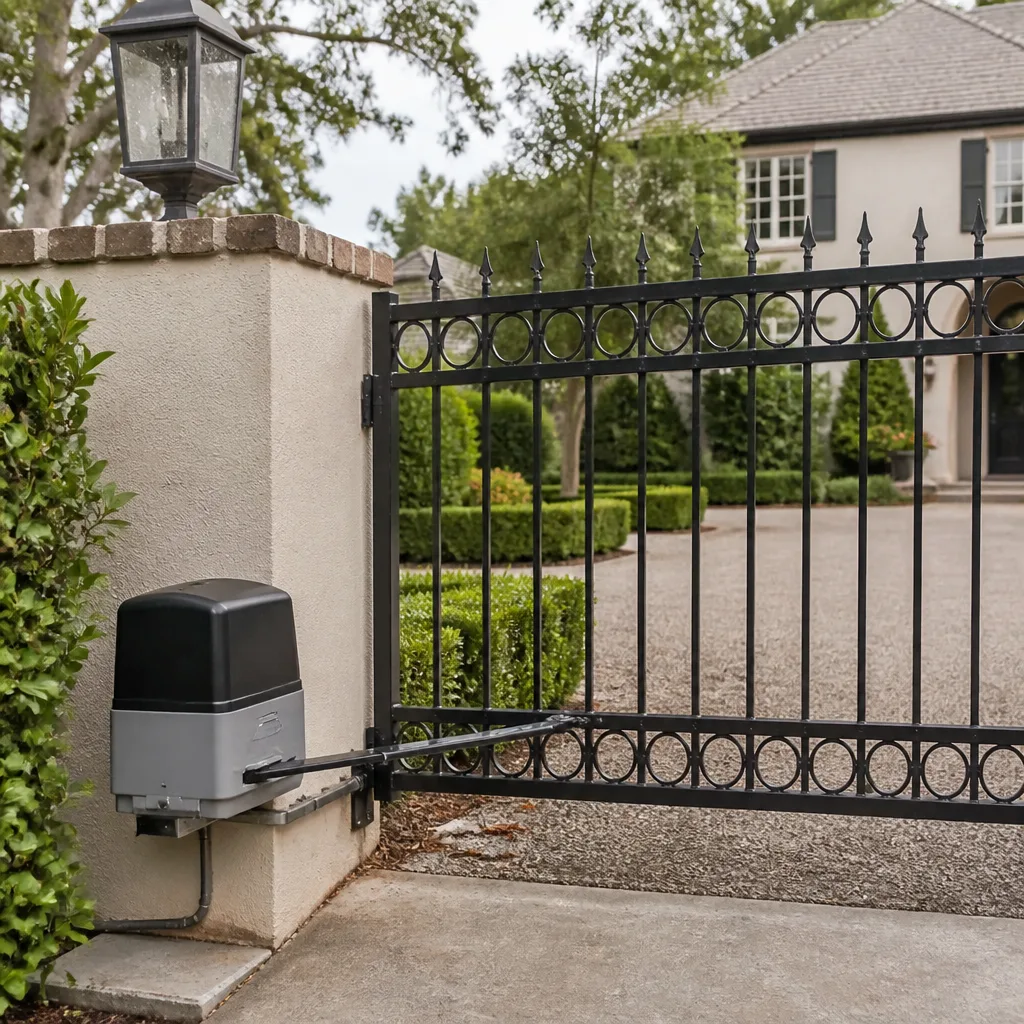
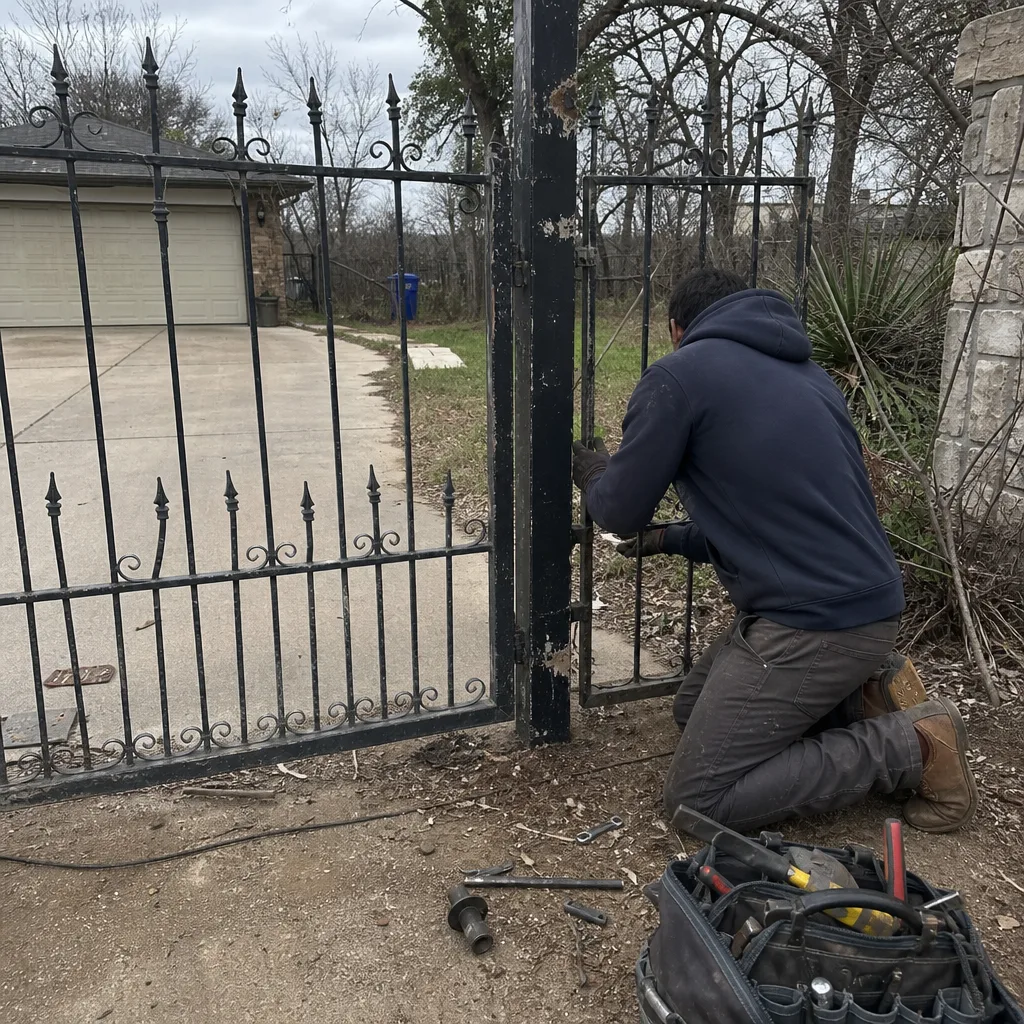 Before
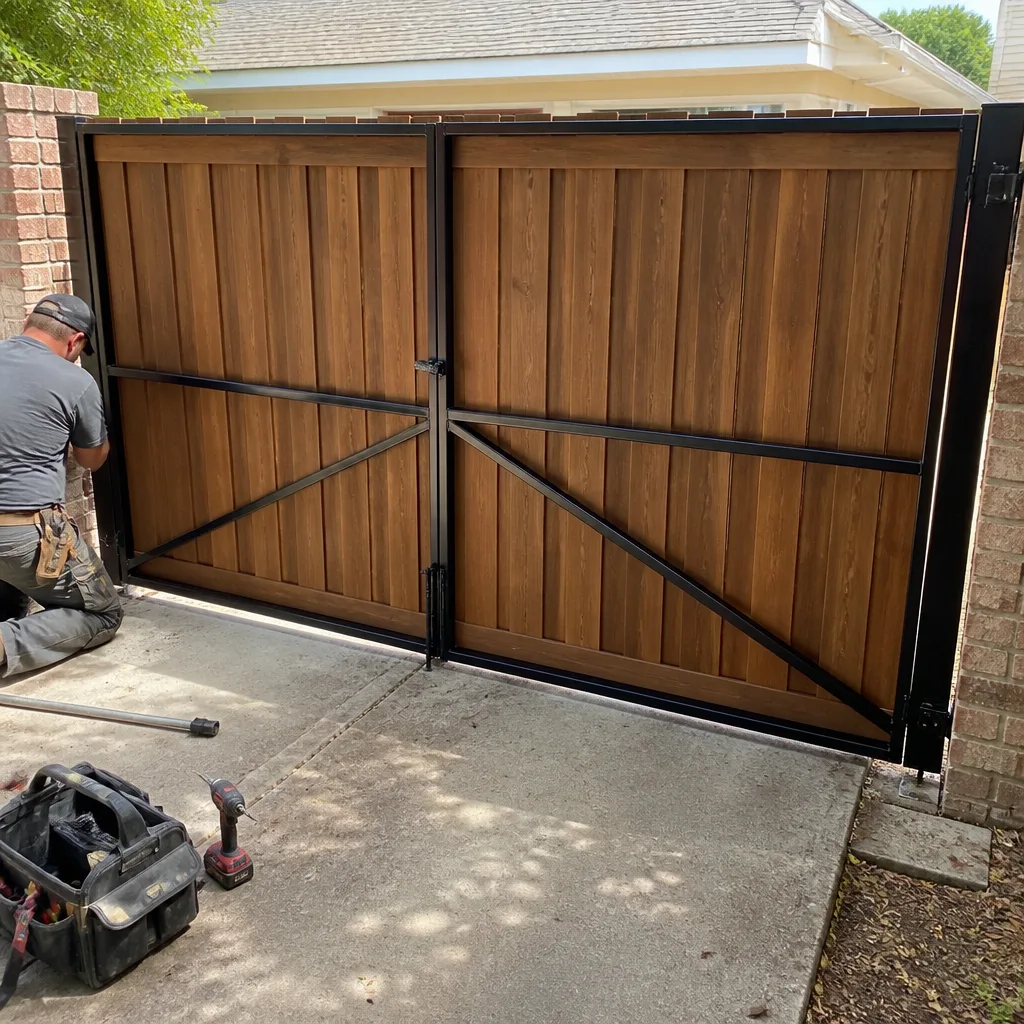 After
After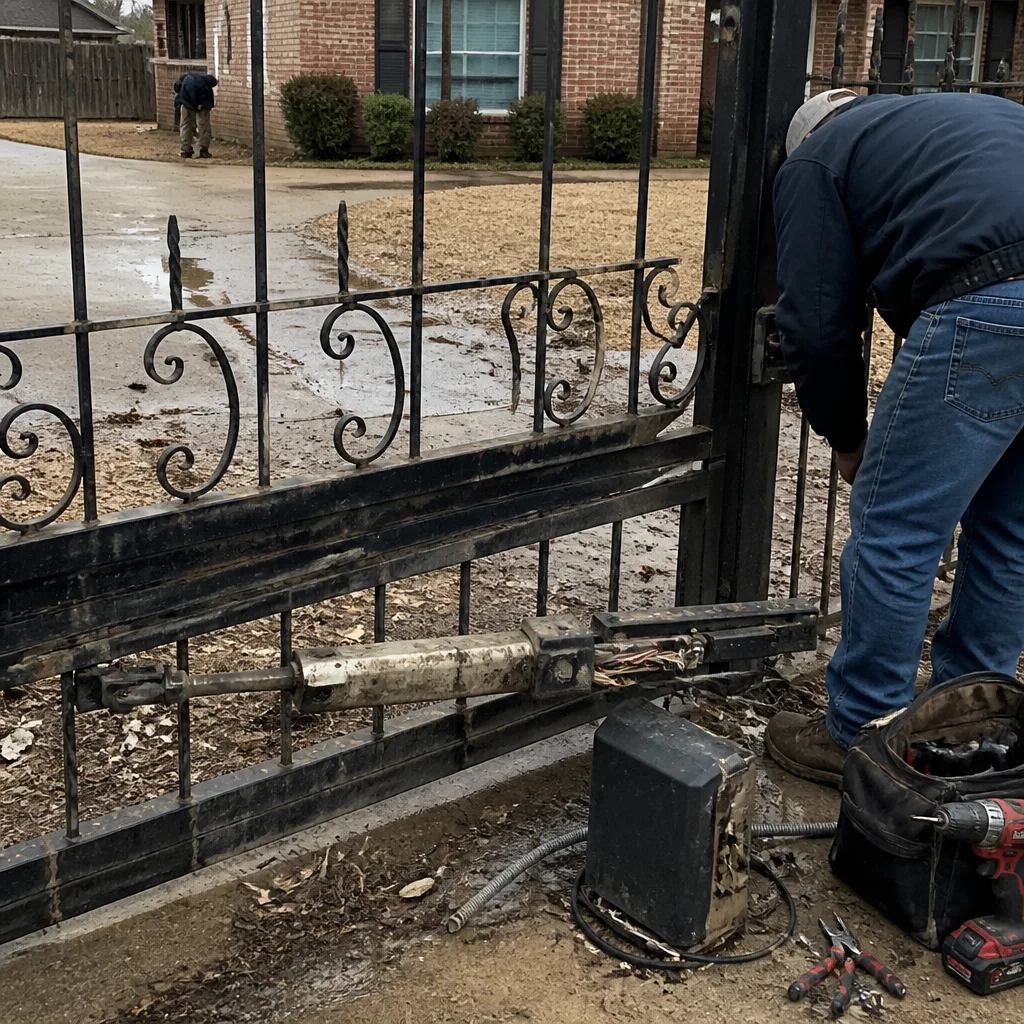 Before
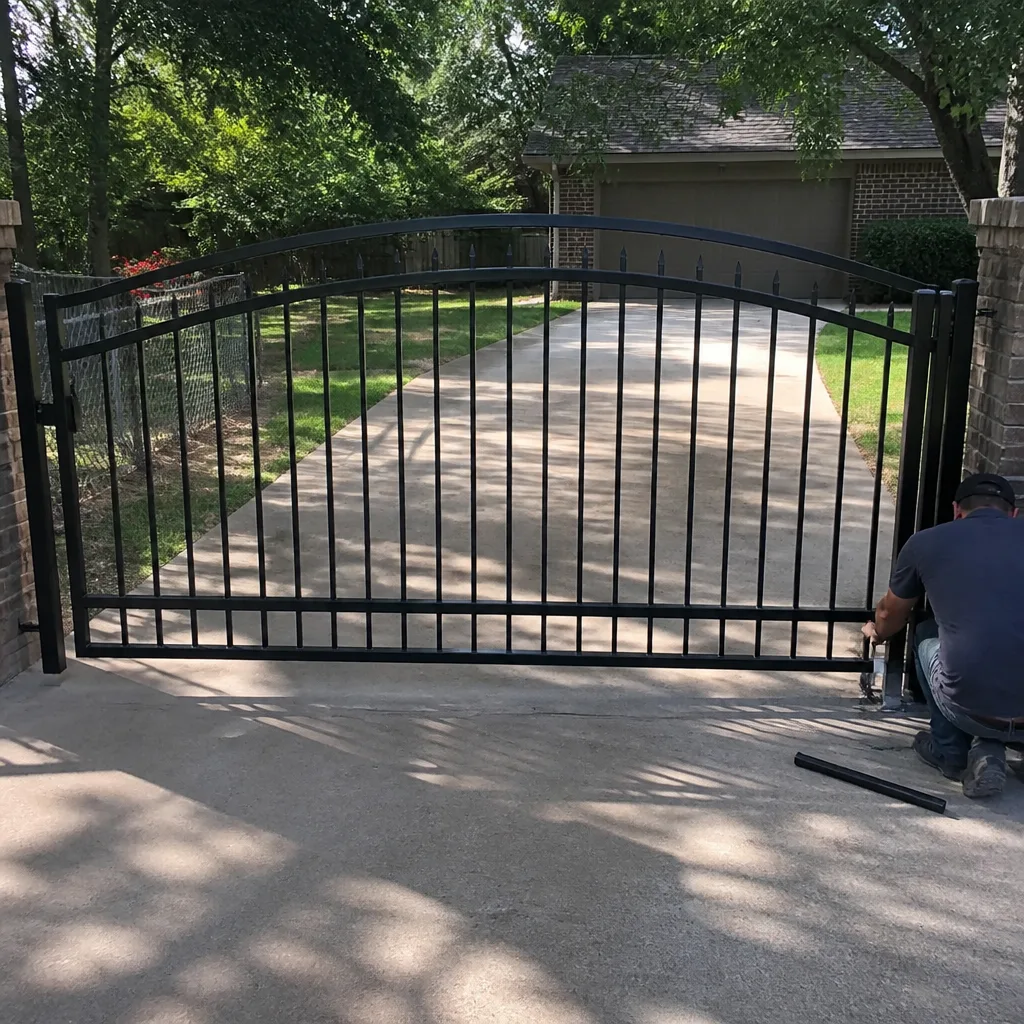 After
After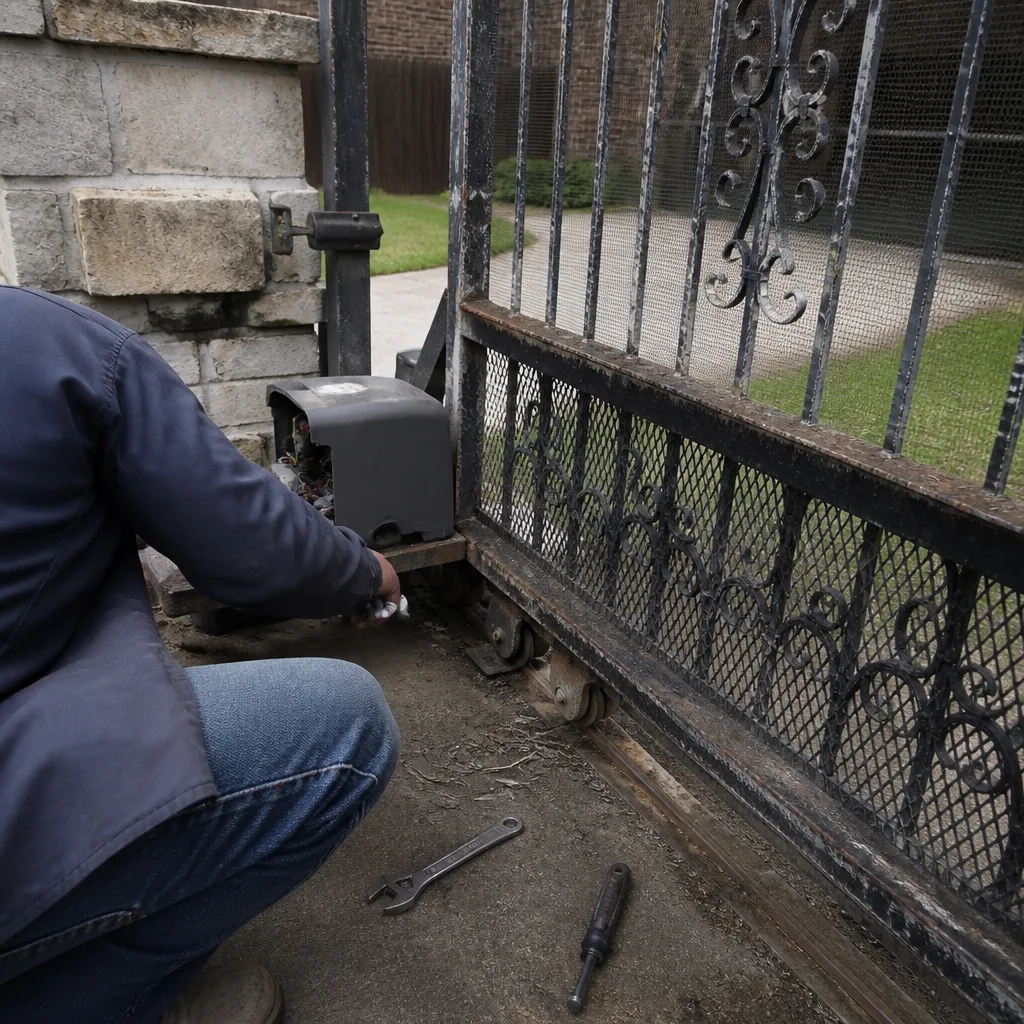 Before
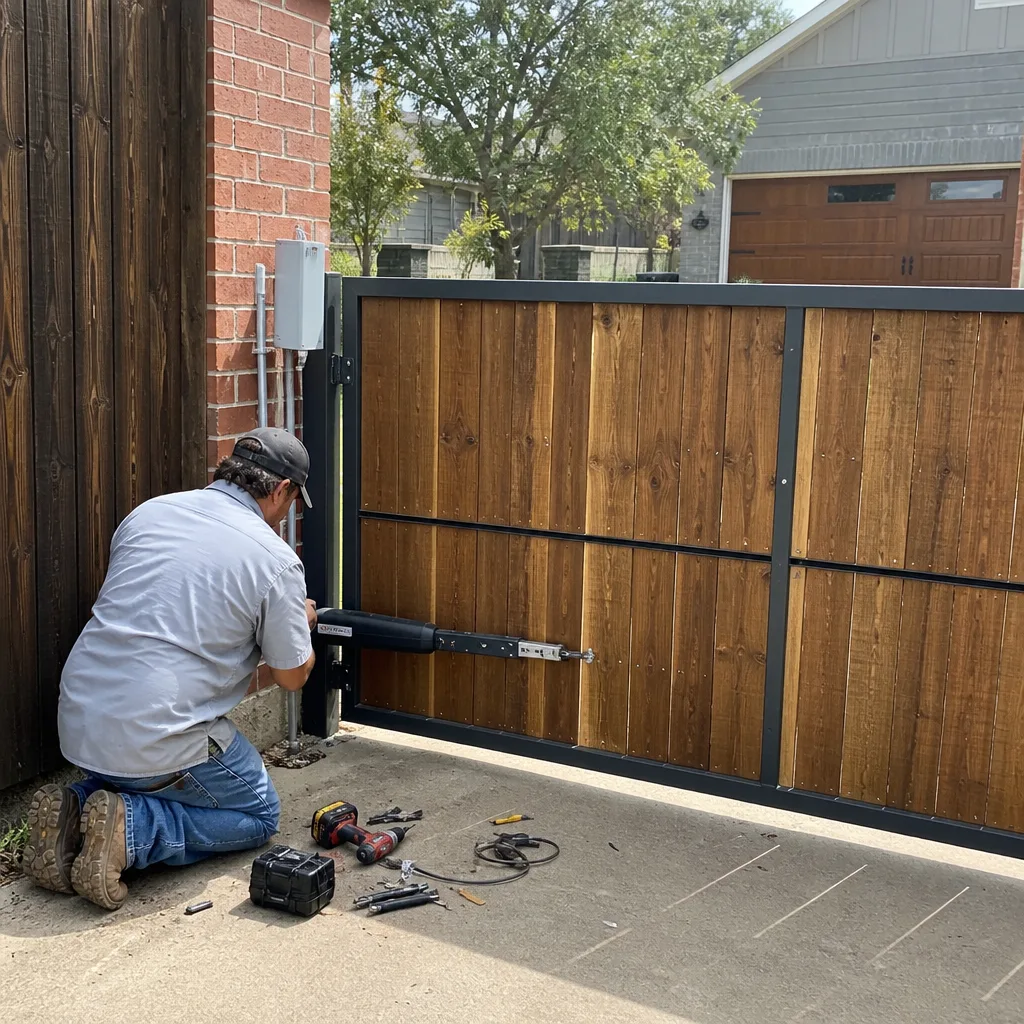 After
AfterThe Complete Guide to Gate Repair in Cleburne
Most gate failures in Cleburne are not the motor. They are the post, the hinge, or the ground the post is set in. The Texas clay under Johnson County expands and contracts through every wet spring and dry summer, and over twenty years that movement quietly pulls a gate out of square until one afternoon the opener strains, the wheels bind, and the whole thing stops. This guide covers how gates are built, how they fail, what repair actually costs in this market, what you can check yourself, and when the right move is to call someone who does this work every day.
Quick Answer
Gate repair in Cleburne typically costs between $175 and $900 depending on whether the problem is mechanical (hinges, wheels, post alignment), electrical (opener board, sensors, keypad), or structural (weld fractures, rotted post, sagging leaf). Most mechanical repairs are completed same-day by a qualified gate technician; automation repairs may require parts for your specific opener brand and take one to three days. Get a written quote before any work begins, and confirm the repair is backed by a warranty.
Table of Contents
- How Gates Fail in Cleburne: Soil, Weather, and Time
- What Gate Repair Costs in Cleburne
- Mechanical Repairs: Hinges, Wheels, Posts, and Welds
- Gate Opener and Automation Repair
- When the Gate Needs Welding, Not Just Parts
- How to Extend the Life of a Gate in Cleburne
- Common Mistakes to Avoid
- When to Call a Professional
- Frequently Asked Questions
How Gates Fail in Cleburne: Soil, Weather, and Time
Cleburne sits on a mix of clay-rich soil that behaves badly with moisture. The same soil that makes foundation repair common in Johnson County is the soil your gate posts are set in. After a wet season, the clay swells and pushes upward. In drought, it shrinks and pulls away from the concrete or steel post. A gate post that was plumb in 2005 can be leaning half an inch by 2025, and half an inch at the post translates to an inch or more at the latch end of a twelve-foot leaf.
We see this pattern across Cleburne neighborhoods: older homes off North Main, acreage properties east of town along Farm-to-Market roads, and newer developments where clay was re-compacted during grading all deal with the same forces. The gate is not failing because it was built poorly. It is failing because the ground underneath it is moving, and the gate was never adjusted to compensate.
Add to that the Texas sun. Powder coat on a steel gate fades and eventually chalks after eight to ten years of southern exposure. Once the coating fails, surface rust begins, especially at weld joints, hinge barrels, and anywhere two pieces of metal rub together. A gate that looks bad is often still structurally sound, but rust at a load-bearing weld is a different matter entirely.
The third factor is usage. A driveway gate on a home with two working cars cycles four to six times per day. That is roughly 1,800 cycles per year. Most residential opener arms and hinge bearings are rated for a finite number of cycles, and after 15 years, a gate has accumulated 25,000 to 30,000 cycles. Parts do not fail mysteriously at that point; they fail on schedule.
What Gate Repair Costs in Cleburne
Here is what we see in the field across Johnson County, based on the work actually being done on homes in and around Cleburne:
| Repair Type | Typical Range | Notes |
|---|---|---|
| Hinge replacement (standard pair) | $175-$350 | Includes labor; heavy ornamental hinges run higher |
| Gate wheel or roller replacement | $120-$250 | Varies with weight rating and bracket type |
| Post re-setting or reinforcement | $300-$700 | Depends on excavation, concrete, and gate size |
| Weld repair (cracked joint or broken picket) | $150-$400 | Small touch-ups lower; structural repair higher |
| Opener arm replacement | $350-$800 | Brand-dependent; LiftMaster and BFT parts differ |
| Control board replacement | $300-$650 | Includes programming and compatibility check |
| Sensor or photo-eye replacement | $150-$300 | Usually completed same visit |
| Full gate realignment and adjustment | $200-$450 | Labor-heavy; multiple adjustments per leaf |
These are honest ranges for the Cleburne market, not national averages. A gate repair quote from a company in Fort Worth may include travel time and a metro markup; a local Johnson County shop does not carry that overhead. At the same time, the lowest bid in Cleburne often excludes things you will need: re-welding a bracket, replacing both hinges instead of one, or adjusting the opener limits after the mechanical work is done.
Before any work starts, the price should be written down and agreed to. No surprises on the bill. If a technician cannot tell you the exact cost before touching the gate, that is a signal to call someone else.
Mechanical Repairs: Hinges, Wheels, Posts, and Welds
The majority of gate failures in Cleburne are mechanical, not electrical. The motor gets blamed because the motor is the part that stops working, but the root cause is often a hinge that has worn into an oval or a gate leaf that has sagged enough to drag on the ground.
How a mechanical repair is done, step by step
- Assessment. The technician checks gate level, hinge play, post plumb, and travel path. On a welded gate, every joint is inspected for stress cracks. On a bolted gate, every fastener is checked for rust and tightness.
- Unloading the gate. For hinge work, the leaf is supported with stands or a lift so that load is removed from the hinge before bolts are touched. Skipping this step is how gates get dropped and bent.
- Repair or replacement. Worn hinges are replaced in pairs, even if only one looks bad. A new hinge next to an old hinge wears the new one out prematurely. If the post has moved, it is re-set and re-anchored before the gate is re-hung.
- Alignment. The gate is adjusted so that the gap is even top to bottom and the latch meets the receiver without force. Opener limits are checked if an opener is present.
- Cycle test. The gate is run through multiple full cycles under power if automated, or swung by hand if manual. The technician is listening and feeling for binding, dragging, or anything that will shorten the life of the repair.
One of the most common Cleburne-specific failures is the concrete mow strip under a swing gate. Over time, the strip settles or heaves, and the gate begins to scrape at the arc end. Adjusting the hinge height sometimes fixes it for a year. Re-pouring the mow strip fixes it for twenty. A good technician tells you which situation you are in, and quotes accordingly.
Gate Opener and Automation Repair
Gate openers in Cleburne run into the same heat and power issues as everything else that sits outside. Capacitors age faster in Texas heat than in cooler climates. Circuit boards expand and contract. Ants build nests inside control boxes, and their bodies short out relay contacts. Power surges from spring storms take their toll on logic boards that were never designed for the spikes we get in Johnson County.
When an opener stops working, the problem is one of the following: no power to the opener, a failed control board, a failed limit switch, a damaged receiver or remote, a triggered safety sensor, or a mechanical failure that is forcing the opener to work against a bound gate. The diagnostic order matters.
We service Linear, Viking, and BFT openers on a regular basis in Cleburne, along with the other major brands. The repair process for a BFT board is different from a Viking arm motor, and a company that only knows one brand will often misdiagnose the other. That is not a knock on generalists; it is a reality of automation work. Gate automation is not gate welding. It is low-voltage electronics married to high-torque mechanical systems, and the skill sets are different.
Safety note: gate openers are engineered with force limits and entrapment sensors, and bypassing those to make a gate “work” is dangerous. A gate leaf can deliver enough force to injure a person or kill a pet. If an opener is reversing unexpectedly, tripping breakers, or sounding an alarm, the correct move is to shut it off at the breaker and call a technician. Do not hold the safety sensor closed with tape to get through the afternoon.
When the Gate Needs Welding, Not Just Parts
Some gates cannot be fixed with replacement parts. A steel gate with a fractured weld at the top hinge, a broken ornamental scroll, or a rusted-through section of square tube needs a welder, not a parts catalog. In Cleburne, ornamental iron gates from the 1970s through the 1990s are common on older properties, and those gates were built with solid stock and stick-arc welds that have held up remarkably well. When they fail, they fail at the thin points: the picket-to-rail joints, the scroll tips, and the bottom rail where water pools.
Welding a gate in the field is different from welding in a shop. The gate is usually still hanging, which means the welder works around awkward positions, wind, and the occasional gust of Johnson County dust. The ground clamp has to be placed carefully to avoid arcing through the hinge bearings. The repair has to be structurally sound and clean enough that the owner is not looking at a smeared glob every time they pull into the driveway.
A proper weld repair includes grinding back the failed joint to clean metal, welding with the correct rod or wire for the base metal, and dressing the weld so it is smooth and paintable. On painted gates, the repair area should be primed and touched up the same day. On powder-coated gates, the touch-up will never perfectly match, but a competent shop gets it close enough that only the owner notices.
We have repaired gates in Cleburne that were built in the 1960s, and with a proper weld job and an adjustment, they close like a new gate. The metal was always good. It just needed someone who respected it enough to fix it right.
How to Extend the Life of a Gate in Cleburne
Most of this is not complicated. It is consistent.
- Lubricate the hinges twice a year. A dry hinge wears an oval into the barrel and the gate starts to sag. Use a spray lithium grease or a heavy oil, not WD-40. WD-40 is a solvent and a water displacer, not a long-term lubricant. In Cleburne’s dry summers, hinges dry out faster than you expect.
- Check post plumb once a year. Stand back and sight down the gate line. If the post leans, the gate is now working against gravity. Early adjustment is a $100 visit. A broken hinge or a re-set post is $400 to $700.
- Wash the gate twice a year. Dirt holds moisture against the metal. A bucket of soapy water and a soft brush removes the crud that accelerates rust. Rinse thoroughly, especially the bottom rail.
- Touch up paint immediately. A scratch that goes to bare metal will rust, and rust never stops on its own. Keep a small bottle of matching paint or clear coat and touch up chips when you see them.
- Test the safety sensors monthly. Place an object in the gate path and press the close cycle. The gate should stop and reverse. If it does not, turn the opener off and schedule a service call. This is a safety issue, not a convenience issue.
- Keep the track or path clear. For slide gates, gravel and grass clippings build up in the track and the gate works harder than it should. Sweep it clean every few weeks during growing season.
A seasonal tune-up in Cleburne runs about $89 and covers the lubrication points, limit switch adjustments, sensor testing, and an overall inspection. It is the cheapest insurance a gate owner can buy, and it catches small problems before they become a new opener or a re-hung gate.
Common Mistakes to Avoid
- Treating the opener as the first suspect. Every time a gate stops, the opener gets blamed. We repeatedly find the real problem in a hinge or a post. Replacing an opener on a gate that is out of square means the new opener will fail the same way the old one did.
- Replacing one hinge instead of the pair. A new hinge next to a worn hinge puts all the load on the new one and it fails in a year. Hinges are replaced in pairs. Any shop that will not do this is saving you money today and costing you money next spring.
- Painting over rust without removing it. Rust is a chemical reaction. Paint seals it in and the rust continues underneath. Wire brush or sandblasting to bare metal, then primer, then paint. Anything else is cosmetic.
- Adding a heavier gate to an existing opener. If you welded extra steel onto a wooden gate or replaced a light ornamental leaf with a heavy privacy leaf, the opener is now undersized. An undersized opener burns out in Cleburne’s summer heat faster than a correctly rated one.
- Ignoring a noise. A gate that screeches at the same point in the arc every cycle is telling you something specific. It is not “just the way it sounds.” Grinding, popping, and squealing are all early warnings. The fix is cheaper now than it will be in six months.
- Using the wrong touch-up paint. There is paint that sticks to galvanized steel and paint that does not. There is paint that holds up to Texas UV and paint that flakes in one summer. Ask someone who knows the difference before you rattle-can your gate.
- Watching the problem get worse because the gate still opens. A sagging gate that still functions will not fix itself, and it will not stay the same. Load on the opener increases, hinge wear accelerates, and one day the whole assembly fails at once. The gate that “works fine but looks a little low” is the gate that costs the most to fix eventually.
When to Call a Professional
Call when a hinge is visibly worn or cracked, when the gate drags or binds at any point in its travel, or when the post leans enough that you can see it from the house. Call when the opener makes a new noise, reverses unpredictably, or refuses to respond to remotes and keypads consistently. Call when you see rust at a weld joint or a crack in the metal, because those are load-bearing points and they fail suddenly. If the gate has hit a car, a pet, or a person, or if the safety sensors are not stopping the gate correctly, shut the opener off at the breaker and call before turning it on again. Ironworks Gate Co. offers free estimates in Cleburne – call (817) 961-9404 and a technician will assess the gate and give you a written price before any work begins.
Frequently Asked Questions
Gate repair in Cleburne typically costs between $175 and $900, with most mechanical repairs falling in the $200 to $500 range and opener or control board work running higher due to parts cost. The exact price depends on the repair type, gate size, and opener brand. Call (817) 961-9404 for a free estimate with the price agreed in writing before work starts.
Most mechanical gate repairs in Cleburne, including hinge replacement, wheel replacement, and weld repairs, are completed in a single visit. Opener board or motor replacement may require parts for your brand, which generally arrive within one to three business days. Same-day service is available for most mechanical work; automation repairs are scheduled once parts are in hand.
Gate sag in Cleburne is caused primarily by the clay soil expanding and contracting under the gate posts, which slowly tips the post out of plumb, combined with hinge wear and, on older gates, fatigue at the weld joints. Dense clay holds moisture through spring rains and bakes into hard pan in summer, and the movement compounds year after year.
We service and repair nine major gate-automation brands, including LiftMaster, FAAC, BFT, Linear, Viking, Ghost Controls, DoorKing, Elite, and Mighty Mule. Whatever opener is on your driveway, the right parts and the right programming knowledge are available in one visit.
Our work at Ironworks Gate Co. is covered by the 90-Day Done Right Promise: if the repair is not right, we come back and make it right, in writing, no paperwork and no arguing. Ask any other contractor if they will put that in writing before they start.
Most weld repairs on residential gates in Cleburne are done on site, with the gate still hanging, using portable welding equipment. The work includes grinding back to clean metal, welding the joint, dressing the weld, and touching up the affected area the same day. Structural breaks in load-bearing points may require additional bracing or reinforcement before welding, and the technician will explain exactly what is needed before starting.
The Bottom Line
A gate in Cleburne lives in soil that moves, heat that bakes, and a usage pattern that never stops. The gate will eventually need work. The question is whether that work gets done by someone who understands the soil, the welding, the opener electronics, and the difference between a temporary adjustment and a permanent fix. Most gate repairs are straightforward; done right, they last for years. Done wrong, they fail again in a season. Get a written price before work starts. Confirm the warranty. And if you want the job done once, call a gate company whose only job is gates. For a free estimate on any gate repair in Cleburne, call Ironworks Gate Co. home at (817) 961-9404.
Written by Victor Salinas, Owner at Ironworks Gate Co., serving Cleburne since 2013.